

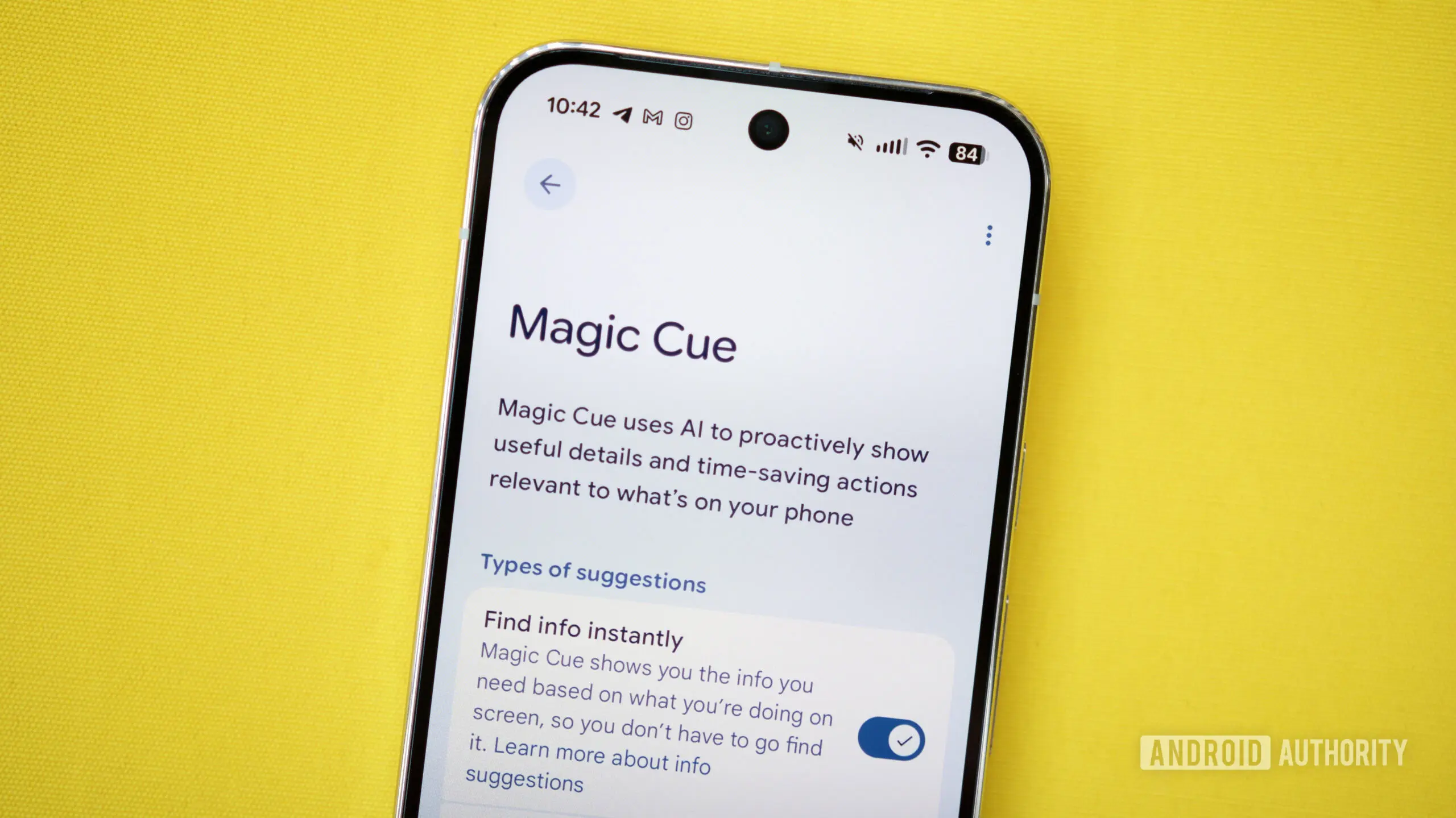
What's in a name? Sometimes, a name tries to keep things tight and descriptive: You don't need to even stop and think about what the Google TV Streamer does. Other names are just utterly obtuse until you have them explained: Good luck guessing what Nano Banana means. Google introduced Magic Cue with the Pixel 10 last year, and unless you're already a user, we'd forgive you for not immediately grasping what it does. But now some new evidence suggests Google could be thinking about a rebrand.
A few months back, we shared with you the new "Proactive Assistance" feature we saw under development for Gemini. Descriptions in the code identified this as a tool using on-screen and notification content from your apps in order to offer suggestions on what you might want to do next. When you think about it, that's not too dissimilar to what Magic Cue does now — and looking at a new find from the team at 9to5Google, there could be a good reason for that.
Checking out Google's latest beta release of the Phone app for Android, they spotted these new strings:
<string name=beacon_proactive_assistance_title>Get helpful info for this call</string>
<string name=beacon_proactive_assistance_description>With Proactive Assistance, Gemini can show you useful info from your emails and messages for this call</string>
<string name=beacon_proactive_assistance_button_description>Get suggestions from Gemini at the right time</string>
The key here is that "beacon" is Phone's internal code name for Magic Cue — only there's no mention of Magic Cue in the accompanying text. Instead, it's possible that this is early groundwork towards repositioning Magic Cue — or at least the functionality we know it for — as Gemini Proactive Assistance. And admittedly, that's a label that looks far easier for users to understand at a glance.
What Magic Cue Does Today
Magic Cue is a feature introduced with the Pixel 10 series that provides contextual suggestions within apps. For example, if you're looking at a restaurant reservation in an email, Magic Cue might offer to add it to your calendar or provide directions. It works by analyzing on-screen content and notifications, then surfacing relevant actions. The feature is designed to operate entirely on-device for privacy, using Google's Tensor chips to process data locally. This has been a key selling point for the Pixel 10, distinguishing it from competitors that rely more on cloud processing for similar AI features. However, the name "Magic Cue" has been criticized as vague and marketing-driven, failing to convey its utility. Users often discover its capabilities only through tutorials or word of mouth.
Proactive Assistance: A More Descriptive Name
The term "Proactive Assistance" is far more intuitive. It clearly indicates that the system takes the initiative to help you, rather than waiting for a command. This aligns with Google's broader push to make Gemini — its advanced AI model — more visible and integrated into daily tasks. At Google I/O 2026 in May, the company showcased a refreshed design for Magic Cue and announced third-party app support. The timing of the rebranding effort suggests that Google wants to unify its AI-powered assistance under the Gemini brand, similar to how it renamed Assistant with Bard to Gemini. The new name could also help users understand that the feature is not just for Pixel 10 but part of a larger ecosystem of proactive AI services.
Evidence from the Phone App
The strings found in the Phone app beta are particularly telling. The internal codename "beacon" for Magic Cue has been directly associated with "proactive_assistance" in the text. The strings describe getting helpful info for a call, with Gemini showing useful info from emails and messages. This is exactly the kind of suggestion that Magic Cue currently provides — for instance, showing caller ID info from your Gmail or suggesting replies based on calendar events. By rebranding to Proactive Assistance, Google can easily pitch the feature to new users: "Gemini will proactively help you during calls." It also opens the door for expansion beyond the Phone app. In the future, Proactive Assistance could work with any app that has relevant data, such as Maps, Messages, or even third-party services.
Device Support: The Big Question
Even if this theory makes a fair amount of sense on face value, we still have plenty of questions about the details, and top at that list has to be device support. Gemini branding feels like a step Google might undertake prior to expanding access to devices beyond the Pixel 10 series. The idea of extending Magic Cue to the Pixel 11 family seems obvious enough, but the question remains of if it has any hope of trickling down to older models, as well. That may require a reimagining of how Magic Cue works, as it's currently designed to operate privately, right on your phone. Offloading some processing to the cloud could allow older Pixel phones — or even non-Pixel Android devices — to run Proactive Assistance, but that would compromise privacy. Alternatively, Google could develop a lightweight on-device model for earlier Tensor chips. The Pixel 10's Tensor G5 was specifically optimized for on-device AI; the upcoming Pixel 11 with Tensor G6 might bring even better efficiency, making Proactive Assistance more capable without cloud reliance.
In addition to that Magic Cue-related content in the Phone app, 9to5Google also found a couple text strings in the Google app referencing Proactive Assistance that have been revised slightly since we last checked in:
Choose apps, like Gmail and Calendar, that Proactive Assistance can use for suggestions
Proactive Assistance uses what's on your screen, your notifications, and info from apps you choose so you can get suggestions at the right time.
These strings emphasize user choice and context awareness. They also hint at a settings interface where users can grant permission to specific apps — a crucial feature for privacy-conscious users. By giving users control over which apps Proactive Assistance can access, Google can balance functionality with trust. This is especially important as regulators and users become more wary of AI's data collection practices. The strings also clarify that Proactive Assistance is not just passive; it actively uses what's on your screen and notifications, precisely what Magic Cue does. The rebranding thus seems to be a natural evolution.
Historical Context: Google's Naming Evolution
Google has a history of renaming its services to improve clarity or align with new strategies. For instance, Google Play Newsstand became Google News, and the old Google Assistant with Bard was rebranded as Gemini. Magic Cue itself was part of a wave of "Magic" features — Magic Eraser, Magic Editor, Magic Compose, etc. — that aimed to convey a sense of wonder. But the 'Magic' prefix has become less distinctive over time, especially as competitors like Apple and Samsung also use 'Magic' in their marketing (e.g., Magic Keyboard, Magic Mouse). 'Proactive Assistance' is more professional and descriptive, likely to appeal to enterprise and productivity users. This shift could also position Gemini as the core intelligence behind all of Google's proactive features, whether it's in the Phone app, Messages, or even Workspace.
Impact on Pixel 11 Launch
With any luck, we may finally get the full story behind these changes with next month's Pixel 11 launch. The Pixel 11 is expected to debut with Android 17 and the Tensor G6 chip. If Proactive Assistance is indeed a rebranded Magic Cue, it would make sense to announce it alongside the new hardware. Google could demonstrate how Proactive Assistance integrates with the Pixel 11's improved camera, new calling features, and deeper third-party app integration. Moreover, the Pixel 11 lineup may include a foldable model and a budget variant, expanding the reach of Proactive Assistance to a broader audience. The challenge will be convincing users that this isn't just a cosmetic change but actually brings new capabilities. Based on the code strings, Proactive Assistance might introduce cross-app suggestions that Magic Cue didn't fully support, such as using data from both Gmail and Calendar simultaneously to prepare for a meeting.
Technical Underpinnings
From a technical perspective, the transition from Magic Cue to Proactive Assistance likely involves deeper integration with the Gemini API. Magic Cue currently relies on on-device models like the EfficientNet for image analysis and BERT-like models for text understanding. Gemini, being a multimodal AI, can process text, images, and even audio in a unified way. By folding Magic Cue into Gemini Proactive Assistance, Google can leverage Gemini's ability to reason across different data types — for instance, recognizing a landmark in a photo and suggesting nearby restaurants from your search history. This would be a significant upgrade. Additionally, the on-device processing requirement might be relaxed with future silicon; Tensor G6 could incorporate a neural engine dedicated to running Gemini Nano, enabling Proactive Assistance to work without internet access. This would preserve the privacy benefits that Magic Cue fans love while allowing the feature to scale.
Competitive Landscape
Google is not alone in pursuing proactive AI assistance. Apple's Siri Intelligence, introduced with iOS 18, offers similar on-device suggestions for calls, messages, and calendar. Samsung's Bixby has also tried contextual suggestions, though with less success. The difference is that Google has the advantage of its vast ecosystem of services — Gmail, Maps, Photos, Calendar, Keep, and more — which provide rich data for proactive suggestions. By rebranding Magic Cue to Proactive Assistance and tying it to Gemini, Google can better communicate this advantage to consumers who may not know that Magic Cue already works across these apps. The new name also helps developers: they can target the Proactive Assistance API (likely replacing the Magic Cue SDK) to have their apps participate in the suggestion pipeline. At I/O 2026, Google showed off third-party app support, indicating that the rebranding may coincide with a broader API rollout.
User Reactions and Expectations
Early adopters of Magic Cue have generally praised its usefulness but criticized its invisibility. Many users reported not even knowing they had the feature until they stumbled upon it. A rebranding to Proactive Assistance could be accompanied by a more prominent introduction during device setup, with a tutorial that explains exactly what it does. The new strings in the Google app also suggest that users will be able to choose which apps contribute to Proactive Assistance, addressing privacy concerns that have dogged similar features in the past. If Google can convince users that Proactive Assistance is both useful and respectful of their data, it could become a marquee feature of the Pixel line. However, some might miss the whimsical "Magic" branding, which gave the feature a friendly, almost playful personality. The name Proactive Assistance is more corporate, but it might be a necessary trade-off for wider adoption.
Future Developments
Looking beyond the Pixel 10 and 11, Proactive Assistance could become available on other Android devices as part of Google Play Services. This would mirror how Assistant and other Google AI features are distributed. Google could also integrate Proactive Assistance with Wear OS, Android Auto, or even ChromeOS, creating a consistent experience across devices. The key will be ensuring that the feature works seamlessly with minimal battery impact. On-device AI has advanced significantly in recent years, and with Tensor chips dedicated to AI tasks, the overhead should be manageable. Google might also introduce a Proactive Assistance API for smart home devices, allowing the Nest Hub to suggest routines based on your schedule. All of this hinges on the successful rebranding and user acceptance. The evidence from the Phone app is just the first piece of the puzzle; we can expect more leaks and beta builds in the coming weeks leading up to the Pixel 11 launch.
With the Pixel 11 launch event just a month away, Google is likely finalizing the software and marketing materials. The inclusion of "Proactive Assistance" in the Phone app beta may be a deliberate signal to developers and power users that changes are coming. Whether it's a simple renaming or a functional upgrade remains to be seen, but the strategic logic is clear: unify AI assistance under Gemini and make it easier for users to understand. The days of "Magic Cue" are numbered, and a more descriptive, powerful "Proactive Assistance" is poised to take its place.
Source:Android Authority News