

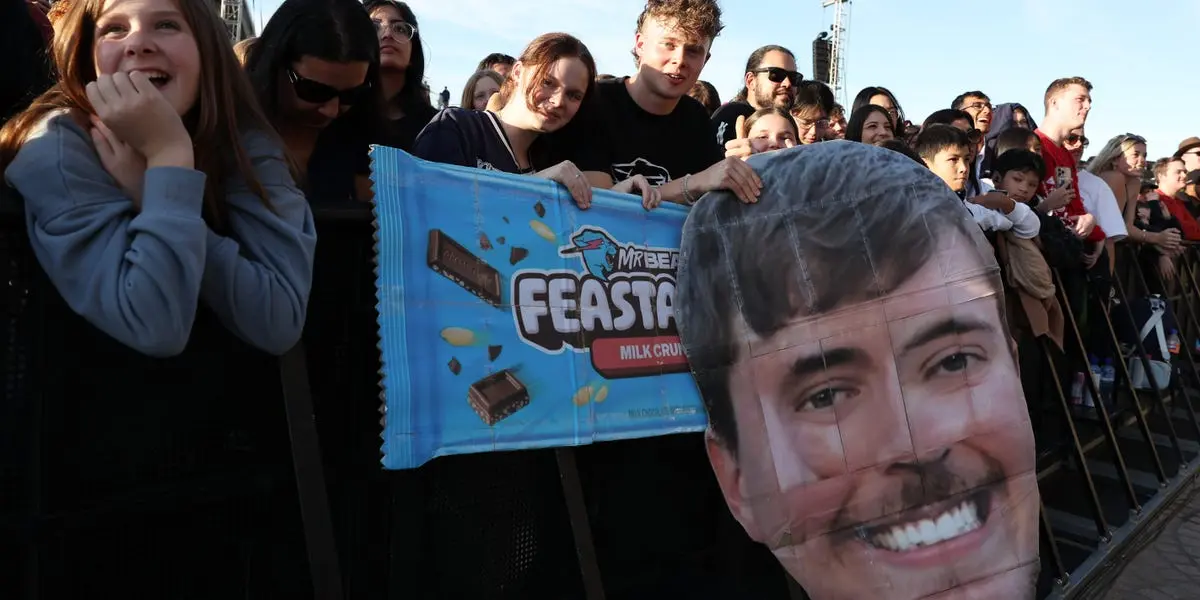
MrBeast's sugar rush is fading. Growth at the top YouTuber's candy company, Feastables, has slowed considerably in the last year, according to internal data reviewed. US sales volume grew 13% year-over-year in 2025, following a 33% leap the previous year, based on a presentation deck dated May 2026. The company sold 7.6 million units in 2024, 8.6 million units in 2025, and 8.8 million units in the 52-week period ended March 2026. These figures represent sales through major retailers and convenience stores, a widely used industry metric.
Launched in 2022, Feastables has been a cornerstone of MrBeast's plans to turn his company, Beast Industries, into a sprawling business empire. Beast Industries was valued at roughly $5 billion in a 2024 fundraise and has recently expanded into areas like finance — with the acquisition of the banking app Step this year — and creator services.
Feastables Had Big Goals
Beast Industries previously set ambitious growth goals for Feastables. A February 2025 investor deck showed Feastables' net revenue more than doubled in 2024 from 2023, to $215 million, and was forecast to grow 74% in 2025, to $375 million. Net revenue represents sales after subtracting things like distribution costs, discounts, and promotional expenses. This often amounts to about half of what the customer pays at the register, said Daniel Scharff, founder of the media company Startup CPG and a former analytics executive for packaged goods makers.
Three industry insiders said Feastables' wide distribution — in chains like Walmart, Target, and 7-Eleven — and its early growth were impressive, especially in a soft market. Chocolate volume sales declined 1.5% in 2025 compared with 2024, according to the National Confectioners Association.
"They grew so fast — their door counts out of the gates were phenomenal," said Mike Duda, managing partner of Bullish, an early-stage consumer investment and marketing firm, speaking about Feastables' wide retail distribution.
It's common for a hot consumer startup's growth to slow over time for any number of reasons. Scharff said a company could decide to pull back on costly promotions, and that brands led by creators or celebrities can sometimes struggle to sustain momentum. "They can be very effective for getting people to try something, but they can not come back for repurchase," he said of celeb brands.
Aimed at millennial parents of young kids, Feastables has made better-for-you and ethical sourcing central to its brand positioning. Last year, it announced that 100% of the cocoa in its chocolate was Fairtrade-certified, meaning it came from cooperatives that follow certain pro-worker practices and avoid the use of child labor. This ethical positioning is a key differentiator in a market dominated by legacy players like Hershey and Mars Wrigley, whose annual sales are in the billions. Feastables products landed on Circana's annual "Pacesetters" lists for 2024 and 2025, a measure of top-performing new products in different consumer packaged goods categories.
At The New York Times' DealBook Summit in December, Beast Industries CEO Jeffrey Housenbold called Feastables the "largest ethically sourced chocolate brand in the world." Housenbold has been bringing in new execs and looking to instill financial discipline at the company since becoming CEO in 2024. Feastables hired Molson Coors vet Michelle St. Jacques as president early this year following the departures of CEOs Alex Zigliara in June 2025 and Jim Murray in 2023.
Beast Industries has sought to reduce its dependence on MrBeast, though Feastables remains closely tied to him and his YouTube content. The deck describes how the brand relies heavily on his promotion to drive awareness, with one limited-edition item selling out almost immediately after he posted about it. Looking ahead, the deck said Feastables is betting on holiday-themed products and new categories like chocolate milk and novelty items.
Beyond the numbers, the slowdown reflects broader trends in the influencer-brand space. Many creator-led products see a massive initial spike due to loyal fan bases but struggle to reach mainstream repeat buyers. Feastables is no exception. The brand competes in a category where household names like Reese's, Hershey's, and M&M's have decades of brand loyalty and deep distribution networks. While Feastables has secured shelf space in thousands of stores, converting trial into long-term loyalty remains an uphill battle.
Feastables also faces challenges on the supply chain and production fronts. As a relatively young company, scaling production while maintaining quality and ethical sourcing standards is complex. The company's commitment to Fairtrade cocoa means higher costs, which could impact margins if volume growth slows further. Moreover, the chocolate market overall is mature, with only modest growth driven by premiumization and snacking trends. Feastables' better-for-you positioning may resonate with health-conscious consumers, but it limits the addressable audience compared to traditional candy that focuses purely on taste and indulgence.
MrBeast, whose real name is Jimmy Donaldson, has built his personal brand on high-stakes stunts and philanthropy, and his business ventures have mirrored that ambition. Feastables was launched with a viral marketing push including a contest where customers could win a chance to compete in real-life games. That initial buzz helped drive early adoption, but sustaining interest without constant new content is difficult. The brand's reliance on MrBeast's social media promotion means any change in his content strategy could directly impact sales.
Despite the slowdown, Feastables remains a significant player in the creator economy and has attracted attention from traditional consumer goods executives. The company's ability to innovate with new formats like chocolate milk and seasonal offerings could reignite growth. However, the path forward requires careful balancing of promotional spending, product development, and operational efficiency. As the novelty wears off, Feastables must prove it can compete on more than just its founder's fame.
The broader context of the confectionery industry also plays a role. Rising cocoa prices, inflationary pressures on ingredients, and changing consumer preferences toward healthier snacks are reshaping the landscape. Feastables entered the market at a time when 'better-for-you' claims were gaining traction, but legacy brands are also launching similar products, increasing competition. Hershey, for example, has introduced organic and low-sugar options, while Mars Wrigley has expanded its portfolio to include fruit-based snacks. Feastables' niche as ethically sourced and socially conscious could become more crowded.
Another factor is the maturation of MrBeast's own YouTube channel. While he remains one of the most-viewed creators on the platform, audience growth rates have slowed as the platform matures and new creators emerge. His business empire now includes multiple ventures beyond Feastables, including his philanthropic Beast Philanthropy, a gaming organization, and the banking app Step. Diversification reduces risk but also requires management attention. The new leadership at Beast Industries is focused on professionalizing operations, which may lead to more disciplined marketing spend and slower growth in the short term.
Looking at Feastables' performance in the 52-week period ending March 2026, the 8.8 million units sold represent a mere fraction of the billions of chocolate units sold annually in the US. Nevertheless, for a brand only four years old, it has achieved remarkable distribution and awareness. The question now is whether it can evolve from a viral sensation into a sustainable business. The answer will depend on product innovation, repeat purchase rates, and the company's ability to reduce dependence on a single personality. While MrBeast's involvement is a powerful marketing asset, it also ties the brand's fortunes to his public image and availability.
In recent months, Feastables has experimented with limited-edition flavors and collaborations, such as a partnership with a popular video game franchise. These efforts are designed to create urgency and generate social media buzz. However, they also run the risk of fragmenting the brand identity if overused. The company's move into chocolate milk and novelty items signals a desire to expand beyond bars and into higher-frequency consumption categories. Chocolate milk, for instance, is often purchased by parents for lunchboxes and could benefit from Feastables' better-for-you positioning. Novelty items, like chocolate-shaped characters from MrBeast's videos, tap into the collector mentality of his young fans.
The industry experts interviewed noted that Feastables' biggest challenge is not initial awareness but sustained trial. While the brand's early adopters are enthusiastic, convincing mainstream consumers to choose Feastables over established favorites requires consistent quality, competitive pricing, and effective in-store promotion. The company's promotional spending, which includes discounts and giveaways, likely boosted early sales but may have compressed margins. As Scharff pointed out, pulling back on promotions can slow volume growth, which appears to be what is happening.
Despite these headwinds, Beast Industries remains well-capitalized and committed to Feastables. The $5 billion valuation from 2024 provides a cushion for experimentation. The appointment of industry veterans like Michelle St. Jacques, who brings experience from a major beverage company, suggests a shift toward more traditional marketing strategies. St. Jacques' background in scaling brands and managing large distribution networks could help Feastables navigate the slowdown and find a new growth trajectory.
In summary, Feastables' growth slowdown is a natural part of the lifecycle for creator-led consumer brands. The initial sugar rush of viral promotion has given way to the reality of a competitive marketplace. Feastables must now prove it can thrive beyond its founder's fame. With a strong ethical stance, innovative product plans, and experienced leadership, the brand has the tools to adapt. However, the coming year will be critical in determining whether Feastables becomes a lasting player in confectionery or a cautionary tale about the limits of influencer branding. The candy industry is watching closely.
Source:Business Insider News