

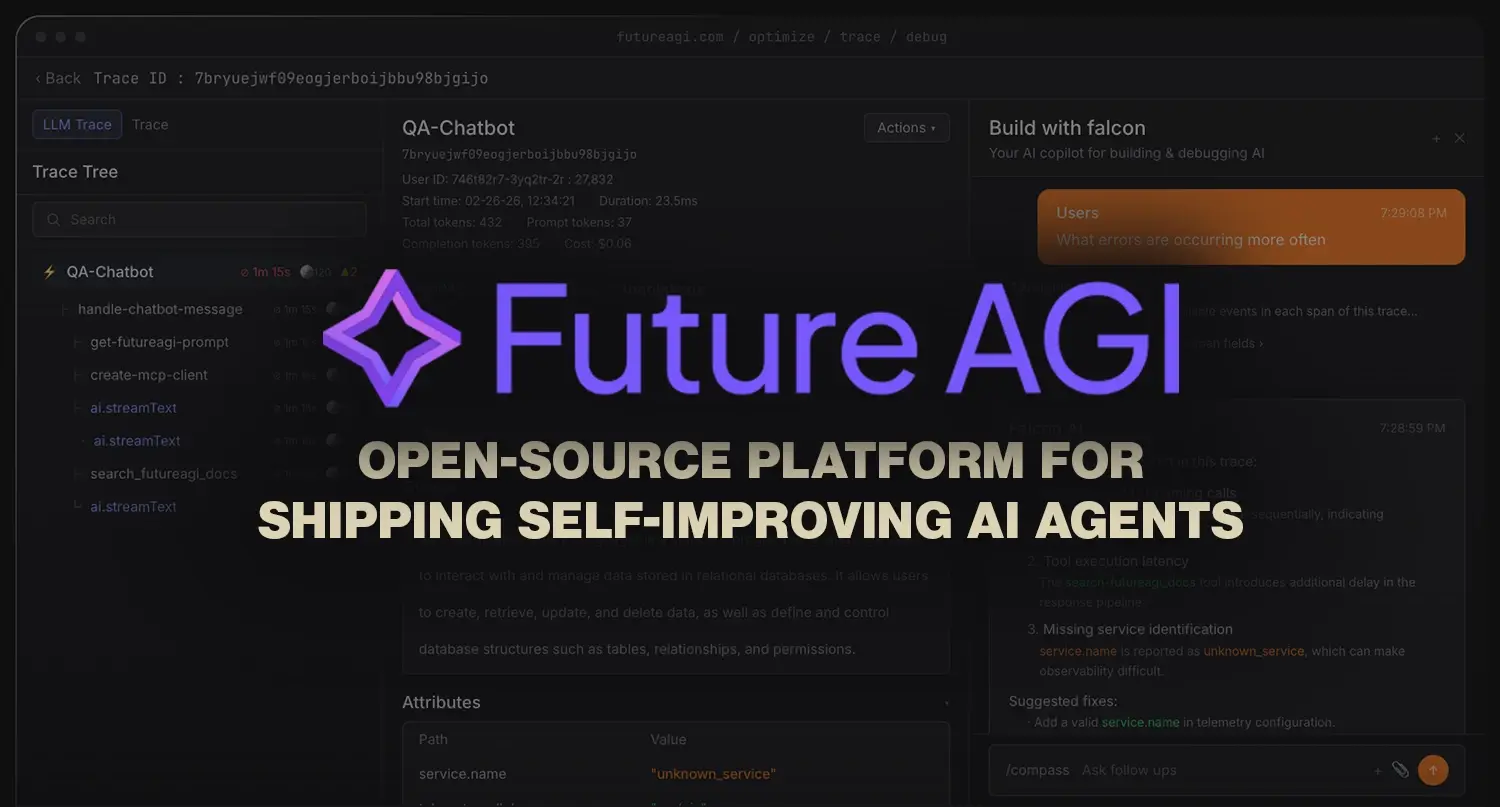
Future AGI has arrived as an open-source control plane for teams shipping self-improving AI agents. The platform, available under Apache 2.0, aims to consolidate the operational layers needed to run LLM agents in production: tracing, evaluation, simulation, and guardrailing. With agents increasingly making decisions, planning multi-step tasks, and using external tools, developers need more than simple logs. They need observability into model calls, tool usage, prompt content, and output quality. Future AGI attempts to provide that in a single, self-hostable system.
The project’s positioning is notable because it targets a specific pain point: the gap between building an agent and shipping it safely. Many frameworks make it easy to define tools and chain prompts, but production teams must handle a different set of concerns. Latency, cost, provider reliability, prompt injection, data leakage, and compliance all become critical. Future AGI bundles these concerns into a platform that can be deployed behind a corporate firewall or in an air-gapped environment.
Key facts at a glance
- Platform: open-source, Apache 2.0, self-hostable
- Purpose: trace, evaluate, simulate, and guardrail LLM agents
- Telemetry: first-boot registration with opt-out environment variable
- Stack: ClickHouse, PostgreSQL, Redis, RabbitMQ, and Temporal
- Gateway: OpenAI-compatible proxy for more than 100 providers
- Security: 18 built-in scanners plus vendor adapters
- Performance: inline scanning P99 at or under 21 ms
- Availability: free on GitHub
Telemetry and first-boot registration
For operators concerned about data leaving their infrastructure, the telemetry model requires close reading. Future AGI states that self-hosted instances register with the project on first boot. This registration sends an instance ID, a version string, a deployment type, and the email addresses and domains of active admin users. The registration happens once, before any user signs in to the dashboard. The opt-out is controlled by a single environment variable, FUTURE_AGI_TELEMETRY_DISABLED=1, placed in .env. It must be set before the first start. If the operator misses that window, the admin list has already been transmitted.
After disabling telemetry, one census ping is still sent with the instance ID, version, and deployment type, but emails are withheld. Periodic heartbeats stop. The documentation also notes that operators should 'turn networking off at the edge if you need full silence.' This is a blunt admission that any network-connected deployment may leak some metadata. For air-gapped environments, the initial registration would physically fail unless network access is blocked, but the design suggests operators should configure the environment variable proactively.
Future AGI lists air-gapped and on-prem deployment as supported and phone-home free. That claim is somewhat in tension with the first-boot registration behavior. The distinction rests on opt-in and on what is sent. A single census ping after telemetry is disabled is still a network event. Teams with strict data sovereignty requirements should test the behavior in a sandbox before rolling out to production.
Deployment and infrastructure
The installer brings up a set of mature open-source components behind a dashboard on localhost:3000: ClickHouse, PostgreSQL, Redis, RabbitMQ, and Temporal. Each component serves a distinct operational role. ClickHouse is a columnar database optimized for analytical queries, suitable for storing and aggregating trace data at scale. PostgreSQL provides a transactional relational store, likely for configuration, users, and metadata. Redis handles caching and can act as a high-speed memory layer for the semantic cache. RabbitMQ is a message broker that can buffer and distribute asynchronous jobs. Temporal is a workflow engine designed to orchestrate long-running, fault-tolerant processes. The combination gives Future AGI a robust foundation for concurrent agent execution.
All spans land in ClickHouse. That includes prompt text, model output, and tool calls, which pass through the tracer on the way into the store. The phrase 'pass through' matters: for a platform that promises comprehensive tracing, every token-rich interaction is potentially persisted. Teams that handle sensitive data need to understand what is stored and for how long. The presence of a defender that inherits access controls on the database suggests an attempt to protect this data at rest, but it also means the security boundary includes the trace store.
Instrumentation across frameworks
The platform supports more than 50 agent frameworks, including LangChain, LlamaIndex, CrewAI, and DSPy, through OpenTelemetry. OpenTelemetry is quickly becoming the standard for observability across cloud-native applications. By building on OpenTelemetry, Future AGI can capture spans from a wide range of AI libraries without requiring bespoke SDKs. This is a major advantage for teams that mix and match frameworks. It also means data can potentially be exported to other observability backends.
The inclusion of DSPy is interesting for self-improving agents because DSPy emphasizes programming abstractions over prompts and can be used for optimizing prompt pipelines. CrewAI and LangChain are widely used for multi-agent orchestration. LlamaIndex is popular for retrieval-augmented generation. Support for these frameworks makes Future AGI relevant to most modern agent stacks.
The gateway sits in front of everything
The Agent Command Center is an OpenAI-compatible proxy that fronts more than 100 providers. This design is central to Future AGI’s value. Rather than allowing each agent to call a model provider directly, all credentials terminate in the gateway. That gives administrators a single choke point to enforce routing, caching, virtual keys, MCP, and A2A.
Routing strategies let teams direct requests to the most appropriate model based on cost, latency, or capability. Semantic caching can reduce redundant calls and save money by reusing responses for semantically similar prompts. Virtual keys allow developers to use the same interface without exposing real provider credentials. MCP, or Model Context Protocol, provides a standardized way to connect agents with external tools and data sources. A2A, or Agent-to-Agent, is a newer pattern for communication between AI agents. The gateway therefore becomes not just a proxy but a policy enforcement point.
Security scanners and guardrails
Protect is the security layer. It ships with 18 built-in scanners for PII, jailbreak attempts, and prompt injection. These scanners can run inline in the gateway, meaning they intercept every request and response, or standalone through the SDK. For inline scanning, Future AGI cites P99 latency at or under 21 ms on the project’s benchmark harness. That is a useful metric, though real-world performance depends on hardware, queue sizes, and the complexity of the detection logic.
In addition to the built-in scanners, vendor adapters cover Lakera, Presidio, and Llama Guard. This allows organizations to plug in existing security solutions. Presidio is a data protection and anonymization toolkit. Lakera provides AI security products. Llama Guard is an input-output safeguard model from Meta. The ability to hook in these vendors means Future AGI can fit into an existing security stack.
Scanners for PII matter because agent traces contain model input and output. If an application uses customer data, prompt logs could include names, emails, or other personal details. Jailbreak and prompt injection detection protect against attempts to override system instructions or force the model into unintended behavior. These are not optional capabilities for large-scale deployments; they are increasingly required by internal security standards and external regulations.
Observability and the self-improvement loop
From a practical perspective, Future AGI’s architecture suggests the team has spent time observing how real AI applications fail. The combination of tracing, evaluation, simulation, and guardrailing covers the full lifecycle. Tracing tells you what happened. Evaluation tells you whether it matched the expected outcomes. Simulation lets you test scenarios before they reach production. Guardrailing prevents bad behavior from having harmful effects. Together, they support the 'self-improving' label by enabling a feedback loop. An agent that is carefully traced and evaluated can be refined with confidence.
But the platform is not turnkey magic. Operators still need to define what 'good' means in their domain, model the evaluation metrics, and decide how to handle incidents. Open-source tools shift the burden to the operator, and Future AGI does not seem to hide that. The documentation with its blunt telemetry note reflects a project more interested in transparency than marketing polish.
For CISOs and security teams, the first-boot registration will likely be the first thing they evaluate. Any open-source component that phones home can be a risk. The existence of an opt-out is good, but the position of that opt-out before startup means it must be included in deployment templates and infrastructure as code. A single setup misconfiguration could expose admin emails. That is not an unusual trade-off in open-source software, but it is worth flagging.
What about 'self-improving AI agents'? The phrase often conjures images of autonomous code generation and recursive self-modification, but in practice it usually means systems that learn from feedback, adjust prompts, or rerun failed tests. Future AGI provides tools to operationalize that cycle. Traces and evaluation results can be used to fine-tune or prompt-optimize. Simulation allows safe replay of past incidents. Guardrails ensure that when the agent changes its behavior, it remains within compliance boundaries.
Future AGI is available for free on GitHub, making the full control plane accessible to teams that want to inspect, modify, and extend it. In a fast-moving segment where proprietary platforms often obscure their internal logic, an Apache 2.0 license is a meaningful alternative. The real test will be operational maturity: how well the telemetry, gateway, and scanners hold up under production load. For now, the project gives the agent engineering community a detailed blueprint for what an open-source AI control plane can look like.
Source:Help Net Security News