

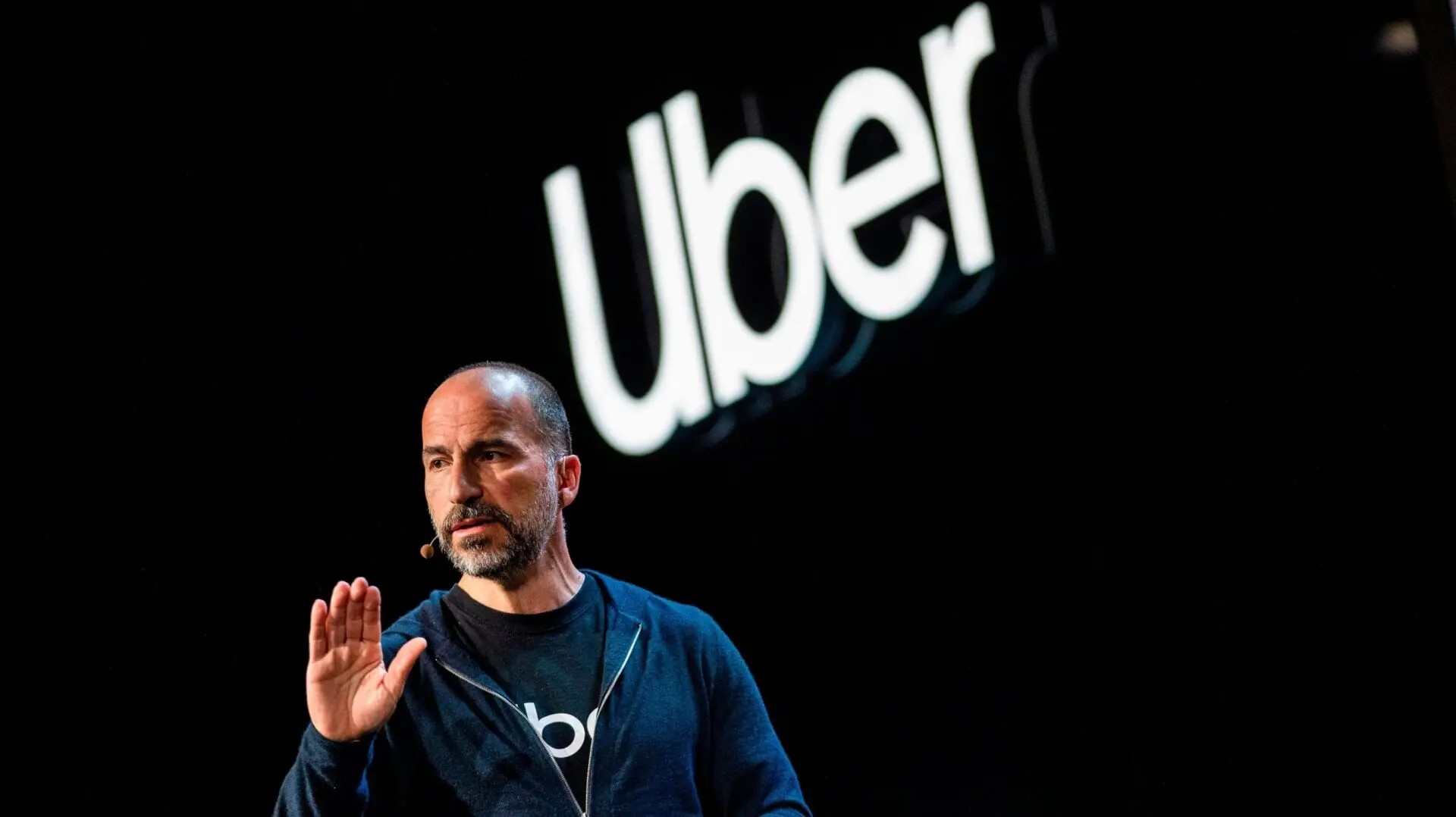
Uber is joining a growing list of Silicon Valley companies that have used efficiency concerns to justify sweeping job cuts. The ride-hailing giant announced that it will eliminate about 10% of its workforce, or roughly 3,300 employees, with a particular focus on middle management and other layers of corporate bureaucracy. The move is being described by the company as a major reorganization rather than a financial rescue, even though it arrives at a time when many technology firms are scrutinizing hiring and overhead costs more closely than ever.
Uber’s structural overhaul
In a memo sent to employees this week, Uber CEO Dara Khosrowshahi said the company is taking steps to become leaner and faster. He cited the need to remove layers, simplify team structures, refine its global location strategy, and focus people and investments against the biggest opportunities ahead of it. That language closely mirrors statements made by executives at other large technology companies that have recently gone through similar workforce reductions.
The cuts will primarily affect middle managers, a category that has become an increasing target across the tech industry. Companies have argued that too many layers of management slow down decision-making and create unnecessary coordination costs. Uber is also reducing the number of employees who sit seven or more layers below the CEO by about 20%, and cutting the number of “micro-teams,” or teams with just one or two direct reports, by nearly 50%. Those numbers suggest that Uber is not simply shedding headcount; it is trying to reshape how work is organized inside the company.
Khosrowshahi’s memo acknowledged that Uber’s growth had created complexity. He wrote that growth had brought more layers, more coordination, and fragmented ownership that no longer serve the company. That language is notable because Uber remains a highly profitable business, especially compared with its early years of heavy losses. The company recently reported $14.2 billion in quarterly revenue and $2.4 billion in net income, both significantly higher than the same period a year earlier. The decision to cut jobs despite those numbers suggests the company believes its problems are structural rather than financial.
Why layoffs despite strong profits?
Uber’s situation raises a question that has become common in the tech sector: Can a company be wildly profitable and still need to lay off thousands of employees? Companies including Amazon and Meta have offered similar explanations in recent years, arguing that their organizations had become too unwieldy to move quickly and innovate at the pace required. Khosrowshahi’s message repeats that argument in nearly identical terms, pointing to bureaucracy as the main reason for the cuts.
But critics and industry observers have also begun asking whether companies like Uber are using AI as a justification for reducing headcount, even when they do not say so directly. Khosrowshahi’s memo does not mention AI at all, which stands out given the amount of attention AI has received across the technology industry. Earlier this year, Khosrowshahi said that about 10% of Uber’s code was already being built by AI agents. Employees in departments such as legal and marketing were also increasingly using AI tools to complete work that previously required more human labor.
According to reports from June, Uber had placed spending caps on some AI tools after blowing through its annual AI budget in just a few months. At the time, the company said it would slow down hiring because of the growing benefits of AI. That comment hinted at a future in which Uber might need fewer people to maintain the same level of output. The current layoffs, even without mentioning AI, could be seen as the next step in that process.
AI and the push for smaller teams
Uber is not the first company to link AI to a desire for smaller, flatter teams. Earlier this year, when Block cut more than 4,000 jobs, CEO Jack Dorsey wrote in a company memo that intelligence tools were making it possible to operate with smaller and flatter teams. That framing has become increasingly popular in boardrooms, where AI is often described not as a replacement for workers, but as a reason to reorganize around fewer layers of management.
The practical effect, however, can be difficult to distinguish from ordinary cost-cutting. Middle managers are often the people responsible for coordinating work, reviewing output, and ensuring quality. When a company eliminates those roles, it may be betting that AI tools can perform some of that coordination and quality assurance instead. But many organizational experts warn that removing middle management too quickly can lead to burned-out employees, lost institutional knowledge, and hidden operational risks.
In Uber’s case, the emphasis on reducing micro-teams suggests a desire to consolidate work into larger, more meaningful groups. Teams with only one or two direct reports may have made sense when the company was growing rapidly and experimenting with new lines of business. Now that the company is focusing on a smaller set of priorities, it may want managers to oversee wider spans of responsibility. That can be a reasonable management practice, but when combined with layoffs and AI adoption, it also signals a fundamental change in Uber’s employment model.
The autonomous driving threat
Another important factor behind Uber’s restructuring is the rapid expansion of autonomous vehicles. Waymo, which is owned by Alphabet, now provides fully autonomous rides in 14 U.S. cities and is quickly moving into more markets. In Atlanta, where Waymo rides are booked through Uber, some drivers have reported lower earnings, fewer ride requests, and longer waits between rides since Waymo launched in the city. That competition threatens the core business model of traditional ride-hailing networks, which depend on large fleets of human drivers.
Uber has been investing heavily in its own autonomous vehicle ambitions in response. The company has struck partnerships with Lucid, Nuro, and Rivian to help build its robotaxi fleet, and has said it plans to invest more than $10 billion to bring autonomous vehicles to market at scale. These are still early-stage efforts, and autonomous vehicle technology has experienced many false starts over the years, but the momentum behind self-driving taxis is no longer hypothetical.
Khosrowshahi wrote in this week’s memo that the job cuts would give Uber more capacity to invest in drivers, couriers, and merchants, as well as to build the autonomous future. That sentence connects the layoffs directly to Uber’s long-term strategy, suggesting that the company is trying to free up resources for big bets on automation and AV deployment. In other words, the cuts are not just about reducing bureaucracy; they are also about redirecting money toward technology that could eventually reduce Uber’s reliance on human drivers.
Historical context of Uber layoffs
Uber has had a complicated history with layoffs, particularly during the early phase of the COVID-19 pandemic, when demand for ride-hailing collapsed. At that time, the company cut thousands of jobs and shuttered several projects in an effort to preserve cash. Since then, Uber has recovered and expanded significantly, branching into food delivery, freight, and other logistics businesses. The company’s headcount grew accordingly, and with rapid growth often comes organizational redundancy.
The latest layoffs may also reflect broader economic pressure across the technology industry. Interest rates have remained relatively high, and investors have become more focused on profitability and efficiency than on growth at any cost. Even companies with strong earnings have faced pressure to show discipline, and workforce reductions have become a common signal that executives are serious about controlling costs. Uber’s healthy financial results give it some cover, but they also make the layoffs more striking to outside observers.
At the same time, there is a genuine debate about whether companies like Uber overhired during the post-pandemic boom. Many technology companies expanded rapidly in 2021 and 2022, anticipating that the shifts in consumer behavior caused by the pandemic would continue indefinitely. When those shifts did not fully materialize, companies were left with more employees than they needed. Middle management often grew faster than frontline roles because each new team needed someone to lead it, and those teams themselves required coordination. The result was a top-heavy structure that many companies are now trying to dismantle.
Uber’s decision to cut so many middle managers can therefore be interpreted as recognition that its organization had drifted toward bureaucracy. The question is whether the company will achieve its goal of becoming faster without losing the benefits of experienced management. Eliminating layers can streamline communication, but it can also mean fewer experienced people available to mentor new employees and catch mistakes before they become costly.
Khosrowshahi’s memo sought to reassure employees that the reorganization would make the company more focused and effective. He described the cuts as a way to give Uber more room to invest in the areas that matter most, including drivers, couriers, merchants, and autonomous vehicles. That vision may prove correct, but much will depend on how well Uber executes the transition and whether AI can truly replace the coordination and judgment that middle managers provide.
For now, the layoffs seem likely to add to the broader unease among technology workers who have watched a wave of job reductions sweep across the sector. Even profitable companies are making cuts, and the reasons often include a mix of AI and organizational simplification, but this is the reality of the technology labor market in the current era.
Uber’s next major test will come as it tries to integrate its autonomous vehicle partnerships and compete with a rapidly expanding robotaxi market. The company has signaled that it is willing to reduce its workforce today in order to build a more automated future. Those investments will need to prove themselves as competition intensifies, but for now Uber says the reorganization is intended to give it room to do exactly that.
Source:Gizmodo News