

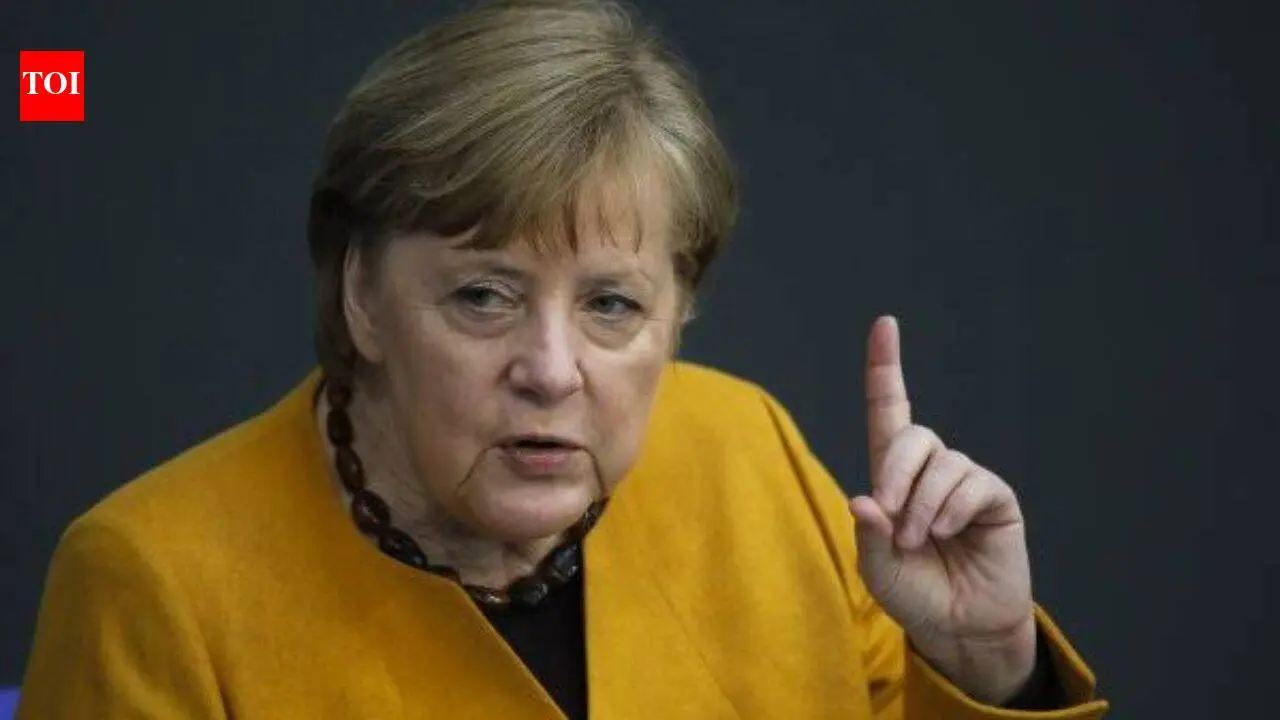
Angela Merkel, Germany's first female chancellor and one of the most influential leaders of the 21st century, once defined her political philosophy in a single sentence. In a July 2005 interview with the Financial Times, she stated: "A good compromise is one where everybody makes a contribution." This quote, offered just months before she assumed the chancellorship, encapsulated an approach that would define her 16-year tenure.
Merkel's words were not merely a platitude. They emerged from a deep understanding of Germany's political system, which rarely grants outright majorities and often forces coalition governments. The quote challenges conventional wisdom, which tends to view compromise as a necessary evil or a simple splitting of differences. Instead, Merkel proposed a more demanding standard: a compromise is only good when every party involved actively contributes something of value, not just gives something up.
The Origins of the Quote
When Merkel gave that interview, she was still campaigning to lead Germany for the first time. The country was emerging from Gerhard Schröder's chancellorship, marked by controversial labour and welfare reforms. Merkel, as chair of the Christian Democratic Union (CDU), needed to articulate a vision that could appeal to a broad electorate while acknowledging the realities of coalition politics. Her remark to the Financial Times was a deliberate signal: she would not govern by imposing her will, nor by making one-sided concessions, but by ensuring that every stakeholder had skin in the game.
This philosophy was tested almost immediately. Her first coalition government, formed in 2005 with the Social Democratic Party (SPD), united Germany's two largest parties, often at odds on issues like taxation, energy, and social policy. The "grand coalition" forced both sides to build policy together. For example, the introduction of a minimum wage—long opposed by the CDU—was achieved through SPD insistence, but in exchange, the CDU secured limits on business regulation and corporate tax cuts. Neither side got everything, but both contributed to an outcome that held for years.
What Merkel Meant by Contribution
The nuance in Merkel's definition lies in the word "contribution" rather than "concession." A concession is something you give up under pressure. A contribution is something you actively bring to the table. In her view, a compromise where one side does all the giving is not a compromise at all; it is an imposition that will breed resentment and eventually unravel.
This distinction is crucial. In many negotiations, parties claim they have compromised when they have merely acquiesced. Merkel's standard forces a different question: what has each party invested in the outcome? If one side walks away having only accepted the other's demands, the deal is fragile. True stability comes when every participant feels they have shaped the result, not just endured it.
Consider the eurozone debt crisis that erupted in 2009. Greece, Ireland, Portugal, and other countries faced sovereign default. Germany, as Europe's largest economy, was pressured to provide bailouts. Merkel insisted on conditions: recipient countries had to implement austerity measures, structural reforms, and fiscal oversight. Critics called the terms harsh, but Merkel argued that without contribution from debtor nations, any bailout would be a handout rather than a partnership. The resulting agreements required both sides to move—Greece accepted cuts and reforms, while Germany committed billions of euros. Whether one agrees with the outcomes, the mechanism reflected Merkel's principle: everyone contributed, and the eurozone survived.
Testing the Principle Through Coalition Politics
Merkel governed through four terms, three different coalition partners, and some of the most divisive debates in modern German history. Her 2009–2013 coalition with the pro-business Free Democratic Party (FDP) was strained by disagreements over tax cuts and nuclear energy. After the Fukushima disaster in 2011, Merkel made a dramatic U-turn, announcing a phase-out of nuclear power—a move that conflicted with the FDP's energy platform. Yet both parties eventually contributed to a compromise that combined accelerated renewable energy targets with compensation for industry.
Her most famous test came in 2015 during the refugee crisis. Merkel opened Germany's doors to over a million asylum seekers, a decision that split her conservative bloc. Within the coalition, the CSU (Bavarian sister party) demanded tighter border controls. The SPD pushed for integration and citizenship pathways. The result was a series of compromises: Germany tightened asylum procedures but also expanded language courses and job training. Every coalition partner contributed something, and the policy framework—though controversial—remained in place for years.
Lessons from the Grand Coalition 2018–2021
The final grand coalition, formed in 2018 after months of deadlock, was the most fragile. Disagreements on immigration, social spending, and climate policy nearly caused its collapse. Yet Merkel's approach of requiring contribution from both sides kept the government afloat. The coalition agreement included a balanced budget (CDU priority) alongside a national carbon pricing system and increased child benefits (SPD priority). Each party could claim victories, and each had to defend compromises to their own base.
Merkel's chancellorship demonstrated that the "everybody makes a contribution" principle works not only in high-stakes politics but also in everyday negotiations. She applied it to EU summits, where she famously said, "There is no secret Merkel plan—only a plan built together." She applied it to climate negotiations, ensuring developing and developed nations both had obligations under the Paris Agreement. And she applied it to domestic debates, from military spending to digital infrastructure.
Why Most Compromises Fail
Most compromises fail because they are not compromises at all—they are capitulations. One side gives ground while the other holds firm, and the arrangement collapses when the loser's grievances surface. Merkel's definition identifies the root cause: lack of contribution. When only one party is responsible for making the deal work, that party eventually tires of carrying the load. Resentment builds, trust erodes, and the agreement falls apart.
In contrast, a compromise where everyone has contributed ownership. Each party has a stake in making the outcome succeed because they helped shape it. This creates accountability and buy-in. Take a simple workplace example: a team dividing a project. If one person does all the heavy lifting while others just nod along, the arrangement is unstable. But if everyone contributes tasks, ideas, or resources, the project is more likely to succeed because each member feels responsible.
Merkel's quote also warns against depending on a single interest group. In the same 2005 interview, she said that anyone in politics must avoid such dependence because it makes real compromise impossible. If a leader owes their position solely to one faction, that faction can dictate terms, undermining the need for mutual contribution. This insight applies beyond politics—in boardrooms, families, and communities, overreliance on a single party creates imbalance.
Applying the Quote in Daily Life
Most people negotiate far more often than they realise—with partners, colleagues, friends, or even themselves. Merkel's standard offers a simple test: has everyone involved actually contributed something to this outcome? If not, the agreement may be temporary.
Consider a couple dividing household chores. If one person consistently does the cooking, cleaning, and errands while the other "compromises" by not complaining, the arrangement is fragile. A good compromise, by Merkel's definition, would have both partners contributing tangible tasks—not just agreeing to avoid conflict. Similarly, in a workplace, if a manager and employee negotiate a deadline, both should contribute: the employee commits to extra effort, while the manager provides resources or flexibility.
The quote also reframes failure. When a deal falls apart, Merkel's framework asks: did everyone contribute? If not, the breakdown was predictable. Instead of blaming one side, we can examine the inequality of input.
Other Notable Merkel Quotes
- "Freedom does not mean being free of something, but to be free to do something."
- "When it comes to human dignity, we cannot make compromises."
- "It's much, much better to talk to one another than about one another."
- "The question is not whether we are able to change but whether we are changing fast enough."
Historical Context of Merkel's Philosophy
Merkel's upbringing in East Germany shaped her view of negotiation. Under communist rule, compromise was often illusory—the state dictated terms, and citizens either complied or resisted. After the fall of the Berlin Wall, Merkel entered politics with a pragmatic understanding of how to build consensus without losing sight of principles. Her scientific training as a physicist also influenced her methodical approach. She famously said she entered politics "to make things better," not to win ideological battles, and her style emphasised evidence over rhetoric.
During the 2008 financial crisis, she applied her contribution principle globally. At G20 summits, she pushed for coordinated stimulus packages and regulatory reforms, insisting that all major economies—not just the United States or Germany—had to contribute to stability. This multilateralism defined her chancellorship and earned her the nickname "leader of the free world" during moments of global turbulence.
The quote also resonates in contemporary times, when polarised societies struggle to find common ground. Merkel's message is that compromise is not weakness; it is a collective act of creation. It requires effort, intention, and genuine engagement from all sides—not a simple splitting of differences but a building of something new.
Source:The Times of India News