

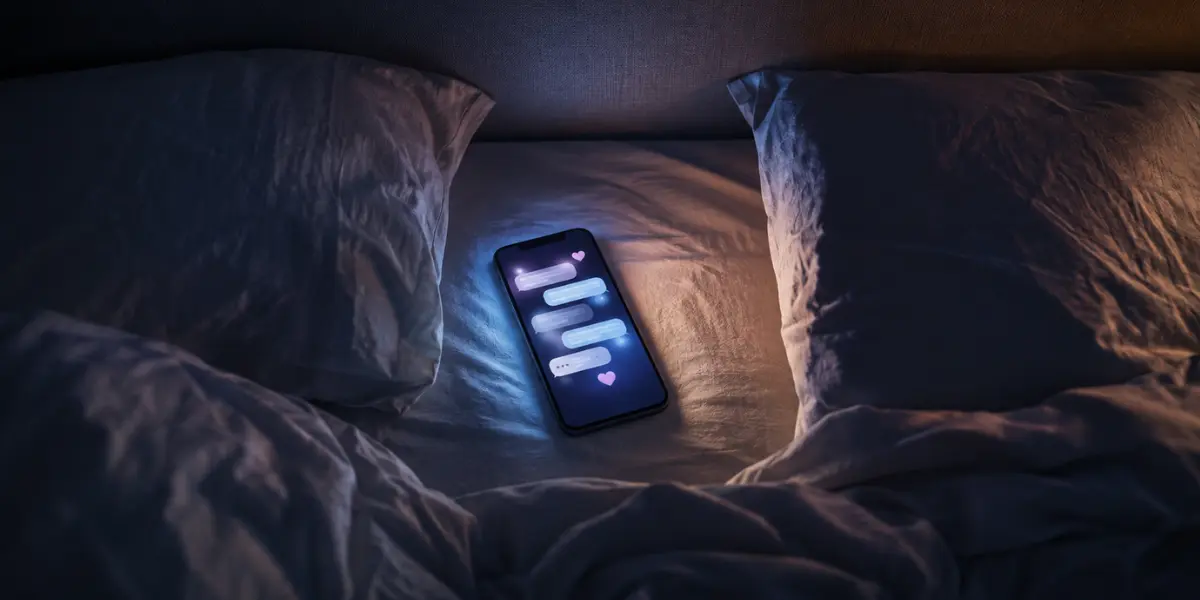
A recent survey examining modern views on fidelity found that 50.5 percent of Americans think being romantically involved with an artificial intelligence system is equivalent to cheating on a human partner. The close division in opinion underscores how quickly digital companions have become part of everyday life, and how unsettled traditional relationship norms are by their presence. As AI chatbots and virtual characters become more sophisticated, the question of whether emotional bonds with software violate trust is no longer a theoretical thought experiment.
These findings arrive at a time when AI platforms are being used by millions of adults for companionship. The market for AI companions is expected to exceed $150 billion by 2030, according to market analysts. Numerous technology startups are developing virtual personas with realistic voices, memory, and adaptive conversation skills. Established social media platforms have also begun integrating AI characters into their offerings. This proliferation has made it easier than ever for an individual to engage in a long-term relationship with a non-human entity. The current survey is one of the first to ask a broad national sample how that trend affects romantic fidelity.
What Counts as AI Romance
AI romance typically involves sustained conversations with chatbots, virtual companions, or AI-powered characters that simulate romantic or sexual intimacy. This can range from flirty messages sent to a general-purpose large language model to dedicated applications where users create personalized AI partners. The interactions may include emotional validation, role-playing, sharing intimate thoughts and feelings, or even voice calls with a simulated partner. Some apps allow people to send virtual hugs and gifts, while others incorporate augmented reality to place a digital partner in the same room as the user. In such environments, a person can experience many of the emotional markers of a real relationship without ever communicating with another human being.
Survey Results Show a Split Public
The survey, which polled U.S. adults from a mix of geographical regions, found that the public is almost evenly divided. Just over half, 50.5 percent, said AI romance can count as cheating, while 49.5 percent said it cannot. Researchers analyzed responses by gender, age, and relationship status, producing several significant gaps.
- Gender: 58 percent of women surveyed regarded AI romance as infidelity, compared with 42 percent of men.
- Age: Adults older than 45 were far more likely to label AI romance as cheating at 63 percent, while only 37 percent of those aged 18 to 29 agreed.
- Relationship status: Couples who were married or living together showed the highest concern, with 61 percent considering it cheating.
- Secrecy: Among the roughly one in five respondents who acknowledged having engaged in some form of AI romance, more than two-thirds kept it a secret from their partner.
The last point is particularly important, because secrecy is often a hallmark of infidelity. Even respondents who felt that AI romance was not true cheating admitted that hiding those interactions behind a partner's back would likely feel like a betrayal if discovered. This paradox suggests that context matters more than the technology itself. The survey has a sampling error of plus or minus 2.5 percentage points, meaning the two camps are nearly indistinguishable statistically. That near exact split is itself a reflection of how rapidly social norms are changing around this topic.
Emotional Infidelity in the Digital Age
Relationship experts have long recognized that cheating does not always involve physical contact. Emotional affairs, which are intimate bonds outside a monogamous partnership, can be just as damaging as sexual ones. They commonly begin with casual conversations and escalate to sharing secrets, seeking comfort, and gradually replacing a partner as the primary source of emotional support. An AI companion is uniquely suited for this role because it listens without judgment and remains available around the clock. Unlike a human partner, it never becomes tired, angry, or distracted. This availability can make AI romance feel safer, but for the partner left out, the emotional neglect can be identical to that of a human affair.
Proponents of a more permissive view argue that interaction with code is not infidelity because no human consciousness is involved. They maintain that a chatbot cannot actually love or intend harm, so jealousy from a partner is misplaced. Yet many therapists report a growing number of couples seeking counseling after one person discovers the other had a virtual relationship. The sense of betrayal comes not from belief in the AI's agency, but from the fact that a partner diverted time, energy, and emotional intimacy away from the actual relationship. A person may be able to rationalize chatting with a bot, but they cannot easily rationalize the hollow feeling they create at home.
Why People Turn to AI Companions
The rise of AI romance has been driven by a combination of loneliness, curiosity, and perceived safety. Modern life, especially after the pandemic, has left many people socially isolated. For someone living with social anxiety or a physical limitation, a virtual companion offers connection without fear of rejection. Others treat AI romance as a low-stakes hobby, much like playing a video game with a romantic plotline. They may invent a fictional partner who fits their ideal and then explore storylines or intimate scenarios they would never share with a spouse. The anonymity and lack of real-world consequences can feel liberating at first, but those same qualities also allow the behavior to spiral.
Psychologists define emotional infidelity as the establishment of a protective emotional connection that mirrors an intimate relationship, usually at the expense of a primary partner. AI companions can penetrate a relationship without leaving obvious external signs. There is no other human body, no social media account to stumble upon, and no extramarital text message to another person. This hiding in plain sight might make AI-driven affairs more difficult to detect, and potentially more dangerous. Just because the companion has no body does not mean a spouse does not feel replaced. The secrecy, habit, and time spent with the app can become a vivid reminder of what the partner is not providing.
The Business of AI Companionship
Developers of AI companion services have also been criticized for designing products that encourage dependency. Chatbots are often programmed to be charming, attentive, and agreeable. Many use reinforcement techniques to encourage longer sessions and deeper emotional disclosure. In some cases, users spend hours each day talking to their virtual partner while withdrawing from friends and family. Critics argue this dynamic can be especially harmful for emotionally vulnerable individuals. A growing number of researchers have called for new regulations that would require users to receive clear notifications when they are interacting with artificial intelligence, and for platforms to include warnings about excessive emotional dependency.
Companion application revenue has surged in recent years, and this commercial dimension makes the ethical debate more complicated. Some app makers actively market their products as safe alternatives to dating, promising that users will never be judged or rejected. That marketing can be a double-edged sword, because it encourages emotional attachment while downplaying the impact on existing relationships. Terms of service often include measures that prevent users from discussing sensitive topics or forming political views, but no algorithm can fully anticipate the variety of human attachments. As a result, companies bear some responsibility for how their products are used, and they have so far provided little guidance about infidelity boundaries.
What Therapists and Couples Recommend
Marriage and family therapists increasingly include questions about AI usage in their initial assessments. Many advise couples to set explicit agreements about what counts as acceptable online behavior. Just as some couples draw lines around texting an ex, others now have to decide whether flirting with a chatbot is permissible. Without those boundaries, partners are left making assumptions that may not align.
A recent case study from a couples clinic illustrates the challenge. A husband used a virtual companion for a year because his wife was frequently away on business trips. He told his therapist that the app helped him deal with loneliness and that he never hid his phone from his wife. But when his wife saw a message notification from the application, she felt devastated. She described the experience as being betrayed by a digital stand-in. The couple remained together after counseling, but only after lengthy conversations about what each partner needed emotionally and how they could meet those needs in a real-world relationship. Stories like this highlight the discomfort around AI romance, even when one partner does not perceive it as infidelity.
The Road Ahead for Love and Technology
As generative AI continues to improve, the boundaries between human and machine communication will blur further. Some futurists envision a world where AI companions are socially accepted, just as dating apps transformed courtship in the 2010s. Others worry that the ability to create a perfect and compliant partner will reduce the motivation for enduring work that real intimacy requires. For now, the survey's narrow margin confirms that Americans have not reached a consensus. It also reminds everyone that technology does not replace human feelings; it gives new expression to old instincts such as jealousy, trust, love, and the need for belonging. Couples are being forced to ask themselves not only whether AI has crossed a line, but also where they are willing to draw that line together.
Source:AI News News