

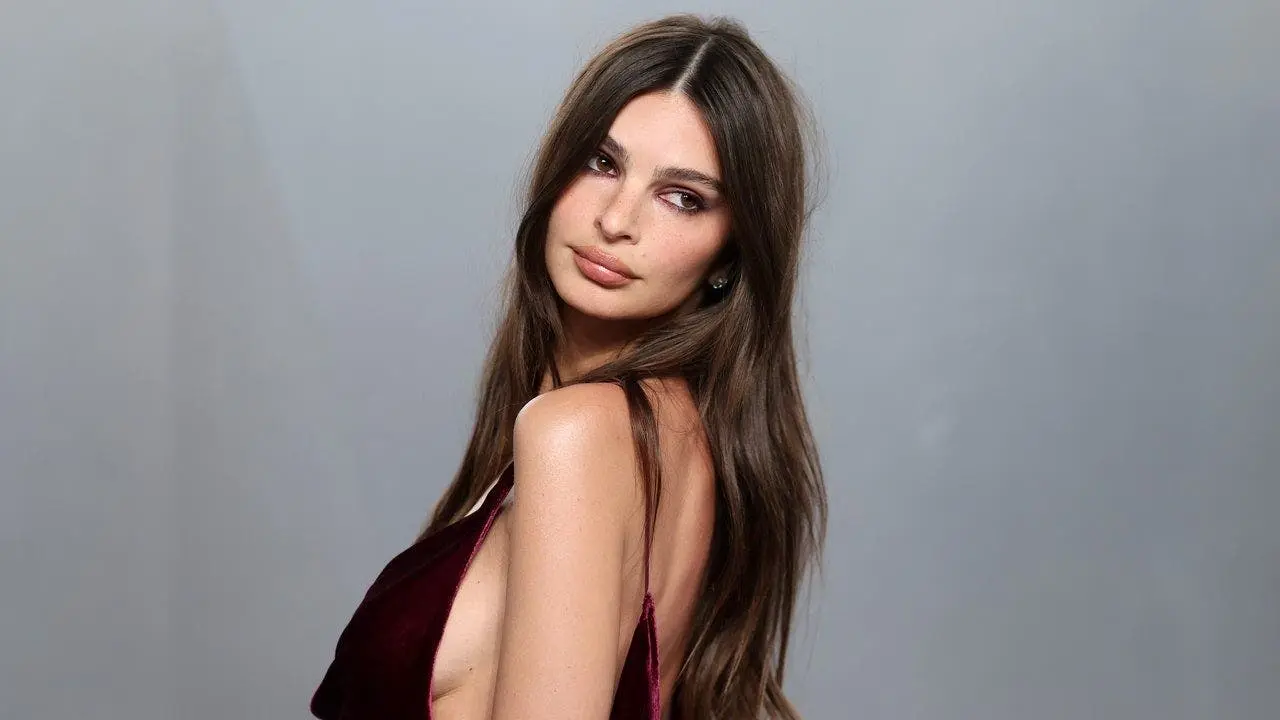
A Supermodel's Honest Confession
Emily Ratajkowski, the 32-year-old model and actress, recently penned a deeply personal essay for The Cut that has ignited a firestorm of criticism. The article, titled 'I Was a Single Mom in Man Hell,' details her whirlwind dating life following her separation from husband Sebastian Bear-McClard in 2022. Ratajkowski, known for her unapologetic stance on feminism and body positivity, admitted that she threw herself into a world of casual encounters—something she had never experienced before—partly to reassure herself that she was still desirable as a new single mother.
In the essay, Ratajkowski recounts the disintegration of her marriage just months after the birth of her son, Sylvester. She describes a 'violent transition' into motherhood, followed by a rapid descent into dates with a series of men she calls 'uniquely disturbed characters from man hell.' Among them were a vegan graffiti artist, a chef who worried he had chlamydia, a Spanish Gen-Zer who wouldn't stop sending nudes, and 'several Italians.' She admits to adopting a 'villain' persona—a mix of Poison Ivy and Catwoman—as a defense mechanism against vulnerability.
The Backlash: 'Out of Touch' and 'Tone-Deaf'
While some fans praised Ratajkowski's raw candor, the essay quickly drew sharp criticism on social media. Many commenters accused the supermodel of being completely disconnected from the realities faced by most single mothers. 'So out of touch and insulting to single mothers who are truly struggling every day just to survive,' read one typical comment on The Cut's Instagram post. Another user wrote: 'A supermodel single mom in her tough struggles… I'm sure every man and woman was reaching out to help her every day. And she could easily afford the best care whenever she wants and the best foods and everything. Spare me. Let's hear a story from a single mom who is financially barely making ends meet.'
The criticism also targeted the accompanying photo of Ratajkowski breastfeeding a baby doll, which many called 'sick' and 'distasteful.' Others took issue with her description of her 'villain' era as a form of empowerment. 'Rich people trying to extrapolate something about their outlandish experiences as truth for the rest of us—read the room, lady,' another commenter wrote.
Yet the essay also had its defenders. 'Love that she's honest & real about this part of her life. Most wouldn't admit it,' one user wrote. Another said: 'Go single moms everywhere but especially in NYC.' The polarized reaction reflects a broader cultural tension around celebrity motherhood, privilege, and the performance of vulnerability.
Background: Emily Ratajkowski’s Career and Public Image
Emily Ratajkowski first rose to fame in 2013 after appearing in the music video for Robin Thicke’s controversial song 'Blurred Lines.' Since then, she has become a prominent figure in fashion and activism, known for her outspoken views on female sexuality, reproductive rights, and body autonomy. She has acted in films such as 'Gone Girl' and 'I Feel Pretty,' and co-founded the swimwear line Inamorata. Her marriage to Sebastian Bear-McClard, a film producer, was relatively private until reports of his alleged infidelity surfaced. The couple wed in 2018 and welcomed their son, Sylvester, in March 2021. Ratajkowski filed for divorce in September 2022, citing irreconcilable differences.
Throughout her career, Ratajkowski has been a lightning rod for debates about feminism and commodification. In her 2020 book of essays, 'My Body,' she examined the ways in which her appearance has been used and controlled by others. Her latest essay can be seen as an extension of that project—an attempt to reclaim her narrative even as she navigates the messy aftermath of divorce.
The Dating Phase: Compulsive Search for Validation
Ratajkowski writes that before her marriage collapsed, she had never had a one-night stand. She had only slept with eight people, four of whom were live-in boyfriends. After the split, she dove headfirst into a world of casual sex, seeking not love but validation. 'What I wanted was his attention: I wanted to feel a man's desire and to be reminded that I was a sexual being, not just a mother of a toddler,' she explained. She describes a 'mania' that drove her from one date to the next, often with alarming speed.
Her description of dating in New York City paints a picture of a chaotic, almost comedic parade of unsuitable partners. The men she encountered ranged from the bizarre to the unsettling. Yet beneath the humor lies a deeper fear—the fear of being a single mother. Ratajkowski writes that even as a child, she saw single motherhood as a 'fastest way to ruin your life as a woman.' That fear, she says, fueled her compulsive behavior. 'Having a child with the wrong man meant having no freedom, no choices, no emergency exit,' she writes.
But the model also acknowledges that her divorce forced her to confront that fear head-on. In a moment of clarity during a meeting with her attorney, who told her 'most women don't leave,' she realized that her decision to walk away was an act of courage, not weakness. 'I left his office that day with an unexpected gift: a new kind of understanding of myself,' she writes. 'Leaving my marriage wasn't about seeking anyone's attention or approval. It was the opposite.'
Societal Reactions and Double Standards
The backlash against Ratajkowski's essay highlights the double standards that exist for single mothers, especially those in the public eye. While celebrity fathers are often celebrated for their dating prowess after divorce, women are frequently judged for prioritizing their own desires. Critics argue that Ratajkowski's wealth and privilege insulate her from the true hardships faced by single mothers who lack financial stability, childcare support, and public sympathy.
At the same time, her essay does touch on universal themes—the fear of losing one's identity after becoming a parent, the loneliness of a broken marriage, and the desperate need for affirmation. By framing her experience in terms of a 'villain origin story,' Ratajkowski attempts to subvert the traditional narrative of the pitiable single mother. Yet for many, that effort falls flat because of her enormous resources.
The controversy also raises questions about the genre of celebrity confessional writing. When a famous person shares intimate details of their life, it can feel both honest and exploitative. Readers are alternately drawn in and repelled by the spectacle of someone who has so much, complaining about what they lack.
The Bigger Picture: Redefining Single Motherhood
Ratajkowski’s essay ultimately argues that leaving a marriage is a superpower—an act of bravery that should be celebrated. She writes: 'Becoming a single mother changed the way people looked at me, exactly as I'd feared it would. But it also allowed me to finally see myself. I wasn't left; I left.' That sentiment resonates with many women who have made similar choices. However, the fact that she can afford nannies, therapists, and endless opportunities for self-care makes her story less relatable to the average single mother juggling multiple jobs and limited support.
Still, the conversation around single motherhood has evolved in recent years. More celebrities are speaking openly about the challenges, from Reese Witherspoon to Drew Barrymore. Ratajkowski's essay adds another layer to that dialogue—one that acknowledges the messy, often unglamorous reality of dating after divorce. Whether it was 'tone-deaf' or refreshingly honest may depend on one's perspective, but it undoubtedly sparked a debate that many are still processing.
As Ratajkowski herself concludes in the essay, the key takeaway is not about the men she dated or the validation she sought, but about the courage to say 'no'—to leave a situation that no longer served her. In that sense, her story, despite its privileges, carries a universal message about the power of self-respect and the importance of moving forward, even when the path is messy and the critics are loud.
Source:Fox News News