

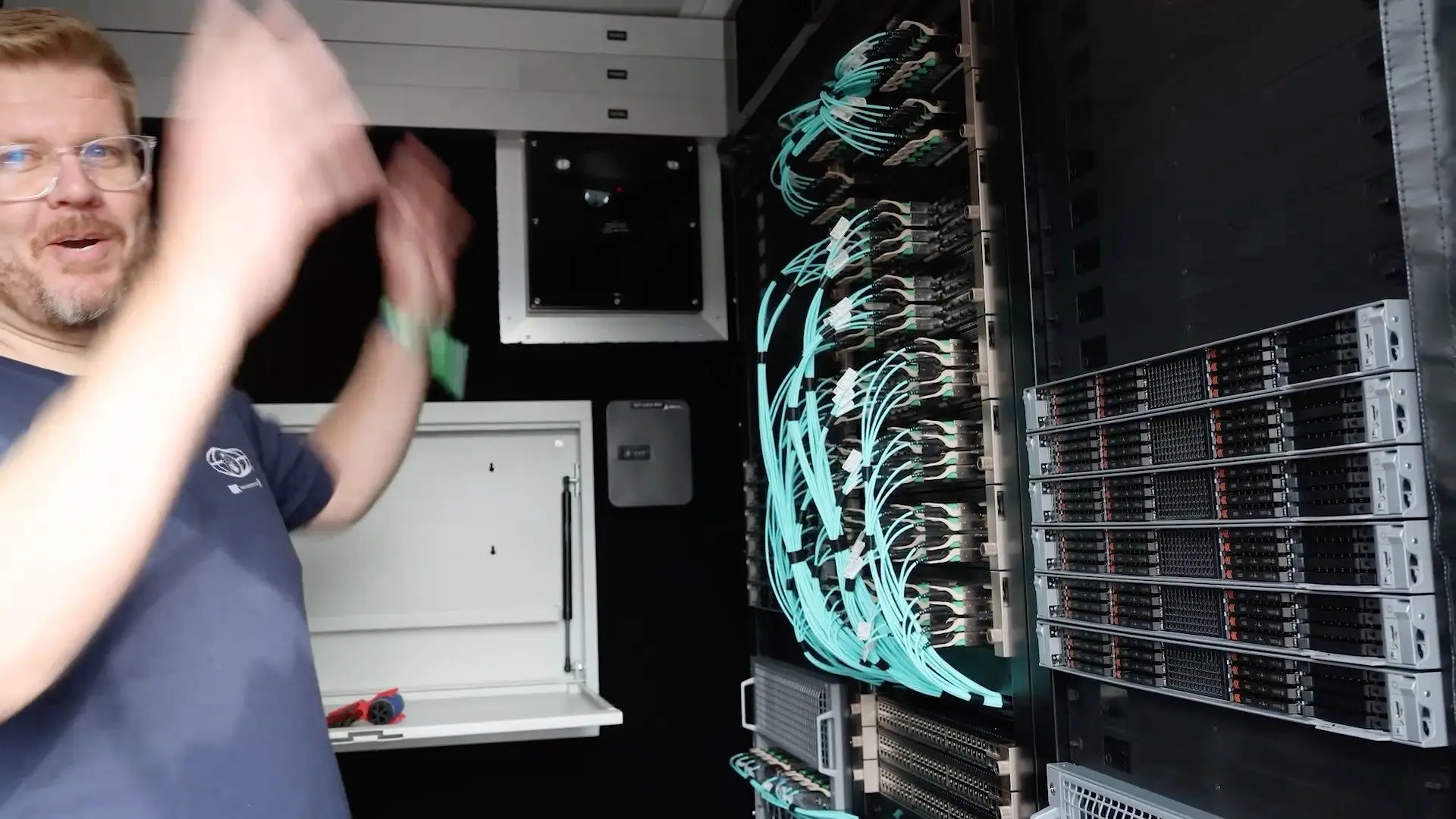
Palantir Technologies has unveiled a new weaponized data center concept aimed at the modern battlefield: a ruggedized shipping container packed with Nvidia's cutting-edge B300 AI accelerators and configured to run open-weight artificial intelligence models. The announcement, made public on Tuesday, signals an aggressive move by the data analytics company to dominate the emerging market for edge-based military AI, where rapid on-site data processing can mean the difference between mission success and failure.
The so-called "war container" is designed to be transported by truck, ship, rail, or heavy-lift helicopter, and can be operational within minutes of arrival at a forward operating base, a contested airfield, or a remote command post. Unlike traditional data centers that require extensive cooling, power infrastructure, and physical security, this self-contained unit integrates its own climate control, power management, and network connectivity. Palantir says the system is hardened against electromagnetic pulses, vibrations, and extreme temperatures, and can be operated by a small team with minimal technical training.
Palantir's Defense Ambitions
Palantir, founded in 2003 by Peter Thiel, Alex Karp, and others, has long been associated with government and intelligence work. Its earliest contracts were with the U.S. intelligence community, and its software platforms have been used for counterterrorism, military operations, and border enforcement. In recent years, the company has aggressively pursued larger defense contracts, including a controversial $178 million U.S. Army contract in 2023 and a multiyear deal with the Defense Innovation Unit. The new containerized data center fits into a broader strategy to position Palantir not just as a software vendor, but as a full-stack partner for military AI infrastructure.
The timing of the announcement is also significant. The U.S. Department of Defense has repeatedly emphasized the need for deployable, resilient AI capabilities that can operate in denied or degraded environments. China and Russia have invested heavily in battlefield AI, and the war in Ukraine has demonstrated the critical importance of real-time surveillance, targeting, and decision-making tools. Palantir's containerized system is an attempt to answer that demand by bringing enterprise-grade compute directly to the tactical edge.
Inside the Container: Nvidia B300 Accelerators
At the heart of the system lies Nvidia's B300 accelerator, the latest addition to the company's Blackwell GPU architecture line. The B300, which began sampling in late 2024 and is expected to ship in volume this year, offers substantial improvements over its predecessor, the H100. It features faster memory bandwidth, higher floating-point throughput, and improved support for large language model inference and training. Palantir declined to specify exactly how many B300 accelerators are packed into each container, but industry analysts estimate a typical 40-foot container could house between 64 and 128 GPUs, depending on power and cooling constraints.
The use of B300 accelerates the container's ability to run massive AI workloads directly on-site. Edge deployment has traditionally been constrained by the size and power consumption of high-performance GPUs, but recent advances in cooling and power delivery have made it possible to fit serious compute into compact enclosures. Palantir says the system can run models with hundreds of billions of parameters, enabling tasks such as computer vision for drone footage, natural language processing for intelligence reports, and autonomous decision support for commanders.
Open-Weight Models and the AI Ecosystem
One of the most strategic elements of the announcement is the emphasis on open-weight models. Open-weight models, such as Meta's Llama family, Mistral's models, and various fine-tuned variants, have their model parameters publicly available, allowing users to run them on their own hardware without relying on a commercial API. For military applications, this is crucial. Classified or sensitive operations cannot always rely on cloud connections, and using open-weight models ensures that the system remains fully functional even when communications links are severed or jammed.
Palantir has been integrating open-source and open-weight models into its AI orchestration platform, known as AIP (Artificial Intelligence Platform). The company has argued that open-weight models give defense customers the ability to customize and fine-tune algorithms for specific missions without exposing data to third-party providers. The containerized data center is designed to run these models locally, with no internet connection required. This also reduces the risk of data leakage, as all information remains within the physical enclave.
Open-weight models also allow for rapid iteration. During a conflict, forces can upload new model weights captured from intelligence or developed in the field, and immediately begin using them. Palantir's software stack includes tools for versioning, testing, and deploying these models across a fleet of containers, so a model updated at a rear headquarters can be pushed automatically to forward-deployed units.
Deployment Scenarios and Operational Benefits
Palantir envisions multiple use cases for its containerized data center. In one scenario, the unit is deployed at a coalition airbase, processing hours of full-motion video from surveillance drones. The B300 accelerators run computer vision models that detect vehicles, weapons, and suspicious movements in real time. Alerts are sent to operators, who can then task additional sensors or launch strikes.
In another scenario, the container serves as a mobile command post for electronic warfare. It analyzes incoming radio signals, identifies hostile emitters, and recommends jamming or deception strategies. Because the system is on-site, latency is near zero, allowing for instantaneous responses to enemy actions. The container can also be integrated with Palantir's existing ontology and data mesh, giving commanders a unified picture of the battlespace that includes friendly forces, civilian populations, and logistics flows.
The system's modularity is another attractive feature. A single container can be scaled by linking multiple units together, creating a larger cluster for more demanding workloads such as training a custom model from scratch. Alternatively, containers can be distributed across different locations to ensure survivability. If one is destroyed by enemy fire, others can continue operating independently.
Power, Cooling, and the Physical Realities
Packing high-end GPUs into a container is not a trivial engineering challenge. The B300 has a thermal design power (TDP) exceeding 1,000 watts in some configurations, meaning a full container could draw more than 100 kilowatts. To cope with the heat, Palantir uses a liquid cooling system circulated through the racks, with a rear-door heat exchanger and an external chiller for temperate climates. For austere environments, the container can instead use a forced-air cooling system that is less efficient but simpler to repair.
Power is equally challenging. The unit accepts a variety of input voltages, including the 3-phase power common at military facilities, and can also be connected to generators or vehicle-mounted power systems. For truly off-grid operations, Palantir offers an optional battery pack that provides a short window of uninterruptible power, allowing the system to ride through power blips or switch generators without shutting down. This attention to physical infrastructure is what separates the container from a standard rack of servers bolted to a cargo pallet.
Implications for the AI Industry and National Security
Palantir's containerized data center represents a deeper convergence between Silicon Valley and the Pentagon. For years, AI companies were reluctant to work directly on military projects, fearing backlash from employees and the public. That changed dramatically after Russia's invasion of Ukraine, and more recently with the rise of generative AI. Today, the defense sector is one of the fastest-growing segments for AI startups and established cloud providers alike.
The announcement also places Palantir in direct competition with other defense technology firms, including Anduril, Leidos, and Northrop Grumman, as well as traditional cloud giants like Microsoft and Amazon, who offer their own tactical edge devices. Microsoft's Azure Stack and Amazon's Snowball Edge were early entrants, but Palantir believes its strength lies in the software layer that sits above the hardware. The company's AIP platform is designed to be hardware-agnostic, but by bundling it with a tuned, high-performance container, Palantir can control the entire stack and ensure optimal performance.
Analysts note that open-weight models are particularly appealing to allied nations that want to retain control over their AI capabilities. A country using Palantir's container can develop its own models or adopt models from other vendors without becoming locked into a single AI provider. This flexibility is likely to be a major selling point in international arms deals, where sovereignty of data and autonomy of decision-making are key concerns.
However, the system is not without its critics. Some experts worry about the proliferation of highly capable AI to countries with less robust safety regimes. An open-weight model, once loaded onto a container, can be modified to interpret orders in unexpected ways. There are also questions about resilience: if the container relies on open-weight models that are widely known, adversaries could develop camouflage or countermeasures that trick its vision systems. Palantir counters that its software includes robust evaluation suites and adversarial testing frameworks, and that the models can be continually updated as new threats emerge.
Looking Ahead
Palantir has not yet disclosed pricing or delivery timelines for the containerized data center, but it is expected to be offered through existing Pentagon procurement channels as well as to foreign military sales. The company is currently showcasing the system to allied defense ministries and is reportedly in talks with several NATO countries. As the global landscape grows more volatile, there is little doubt that battlefield AI will become a core capability for modern militaries. Palantir's container, blending off-the-shelf Nvidia hardware with its own proprietary orchestration software, is a bold attempt to become the default infrastructure for these future operations.
Source:TechRadar News