

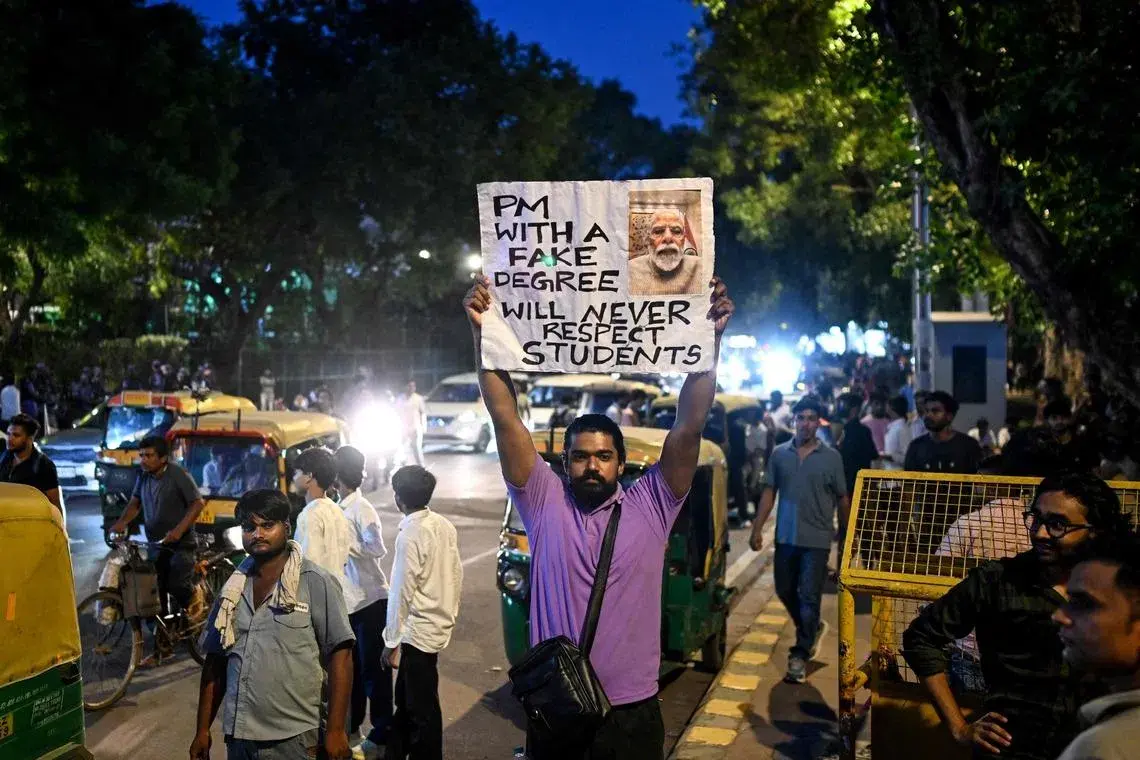
NEW DELHI – When Indian Prime Minister Narendra Modi’s government cut mobile internet services at the site of youth-led protests in New Delhi, students found new ways to stay in touch. Thousands of young people have been protesting, some camping under tarpaulin in the capital, demanding changes to the education system after a series of irregularities to life-changing exams, including leaks of some papers. India’s Ministry of Home Affairs issued an order suspending mobile internet services for eight hours on Thursday within 1.5km of the protest site. The action was needed “in the interest of public order and for preventing incitement to the commission of any offence”, said the document, published on the ministry’s website.
Some students simply switched to Bitchat – a peer-to-peer messaging system that relies on Bluetooth to link people who are nearby into an ad-hoc network without using the internet. “Many people are using Bitchat,” Kumar Shalabh, 21, said of the open-source app developed by American tech entrepreneur Jack Dorsey. Shalabh is among the many protesters demanding change and the resignation of Education Minister Dharmendra Pradhan. Shalabh used artificial intelligence services Claude and ChatGPT to seek out new ways to communicate. “They think we are just part of the internet. Yeah, we know the internet – we also know how to communicate without the internet,” he said. “They think we are dumb, we are foolish, but actually we are quite smart.”
Bitchat founder
The demonstrations led by the social media-driven Cockroach Janta Party this week have become one of the biggest challenges to Hindu-nationalist Modi’s administration since his 2024 re-election for a third term. The protest has evolved to include concerns over unemployment, opportunities for young people and what critics have called Modi’s increasingly authoritarian style of governance. As tensions escalated, notably when police fired tear gas and used batons against tens of thousands of demonstrators on July 20, protesters said their mobile internet communications slowed or stopped. Some of the students, most of them Gen Z, said they were ready.
Khushi, who only gave her first name, said she and her friends decided where to meet before leaving home because they anticipated network interruptions at the protest site. “Then there is Bitchat, where you can message using Bluetooth,” the 19-year-old told AFP. On July 24, Bitchat founder Dorsey shared another government document in a post to X and said: “The government of India does not like technologies like Bitchat and wants it taken down.” Digital rights advocates have demanded that the newest order be revoked. “We stand with the developers and the young protesters whose speech this order seeks to silence,” the Internet Freedom Foundation said.
Reaching people
Internet shutdowns in India, the world’s largest democracy, are frequent. According to international non-profit Access Now, India ranked second globally in 2025 in internet shutdowns, imposing 65 “during protests, conflict, communal violence and religious holidays”. Digital rights activist Nikhil Pahwa said he was not surprised when mobile internet services were suspended this week. “That’s how the state responds, because it doesn’t have the ability or the capacity or the sense of how to deal with protests or with issues,” he told AFP. “And its first port of call is to block access to the internet to prevent information from spreading.” Many people in India relied on internet connections to make digital payments, he said. Despite finding alternatives to mobile internet services, many protesters struggled to communicate with one another and with worried family members back home. “Basically, calls are coming, but they are not able to hear us,” said 19-year-old Gunveer Singh. “Internet works or not, the message is reaching people, and that will keep happening,” he added.
The use of Bitchat is a testament to the ingenuity of India’s Gen Z protesters. Bluetooth-based mesh networks have been used in other contexts, such as during Black Lives Matter protests in the United States, but their adoption in India marks a new chapter in digital activism. The app, which is open-source and decentralized, allows users to send messages and even broadcast to multiple people without any central server. This makes it extremely difficult for authorities to block or monitor. The Indian government has historically targeted such tools; in 2021, it ordered the removal of the app Bridgefy from app stores after it was used during farmer protests. The current protests, triggered by exam paper leaks in the National Eligibility cum Entrance Test (NEET) and the University Grants Commission-National Eligibility Test (UGC-NET), have exposed deep flaws in the education system. NEET is a high-stakes medical entrance exam that determines admission to top colleges; leaks in May and June led to widespread anger. The government’s response has been to arrest a few people, but protesters demand systemic reform and the resignation of the education minister.
The Cockroach Janta Party, a loose coalition of young activists named after a cockroach that is often associated with resilience, has been organizing protests through social media. Their demands have grown to include a crackdown on corruption, job creation, and an end to what they see as an authoritarian drift under Modi. The prime minister, who won a third term in 2024 with a reduced majority, has been accused by critics of suppressing dissent. The internet shutdowns are part of a broader pattern: since Modi first came to power in 2014, India has become one of the most frequent users of internet blackouts in the world, according to reports by Access Now and the Economist Intelligence Unit. In 2024 alone, India recorded over 100 shutdowns, affecting millions of people. The government defends these actions as necessary for national security and public order, but digital rights groups argue that they violate constitutional freedoms and international norms.
The Gen Z protesters are acutely aware of these issues. Many of them are from middle-class families, attending coaching classes in Delhi to prepare for competitive exams. The leaks have shattered their trust in the system. “We studied for years, and then everything is decided by a leak,” said 20-year-old Priya, another protester who preferred to use only her first name. “The internet shutdown is just another way to control us. But we are not afraid.” She uses Bitchat alongside traditional methods like hand signals and predetermined meeting points. The protests have also seen innovative use of offline communication: colorful banners, chants, and even a massive human chain around the protest site to block police movements. The government, meanwhile, has tried to downplay the scale of the movement. Home Minister Amit Shah said in Parliament that only a “small group of miscreants” was behind the trouble, but the sustained presence of thousands of young people in the capital suggests otherwise.
International observers have noted the significance of these protests. The United Nations Office of the High Commissioner for Human Rights expressed concern over the internet shutdowns, urging India to respect freedom of expression and assembly. Amnesty International called the blockades “a dangerous precedent for a democracy.” Domestically, opposition parties have seized on the issue, accusing the Modi government of undermining democratic institutions. However, the young protesters remain independent and non-partisan, focusing on their immediate demands. “We are not with any party,” said Shalabh. “We are with the truth.” As the protest enters its second week, the government shows no signs of backing down. But the Gen-Z protesters have demonstrated that even without internet, they can adapt and persist. The use of Bitchat may become a symbol of a generation that refuses to be silenced.
Beyond the immediate protests, this episode highlights a deeper digital divide. While India boasts one of the largest internet user bases in the world, with over 800 million connected individuals, the government retains the ability to cut access at will. This power is increasingly used not just in conflict zones but also in urban centers like Delhi. Tech companies like Twitter (now X) and WhatsApp have also faced pressure to comply with government takedown requests. For the protesters, Bitchat is a temporary fix; it works only within a range of about 100 meters, so it cannot replace full internet connectivity. Yet it has allowed them to coordinate logistics, share information about police movements, and maintain morale. The app’s founder, Jack Dorsey, has publicly supported the protesters, offering to help improve the app’s functionality. This has further annoyed the Indian government, which has a history of clashing with tech giants over content moderation and data localization.
As the standoff continues, the world watches to see whether India’s young citizens can force change. The exams scandal has already led to the cancellation of some tests and a probe by the Central Bureau of Investigation. But protesters want more: a complete overhaul of the examination system and accountability for those responsible. The internet shutdowns have only strengthened their resolve. “They think blocking the internet will stop us,” said Khushi. “But we were born without constant internet. We know how to talk to each other. We are the generation that grew up with offline games and real conversations. This is just a new game for us.” Her words capture the spirit of a movement that is redefining civic engagement in the digital age. Whether it succeeds remains to be seen, but one thing is clear: India’s Gen Z is not going to be silenced by a mere switch.
Source:The Straits Times News