

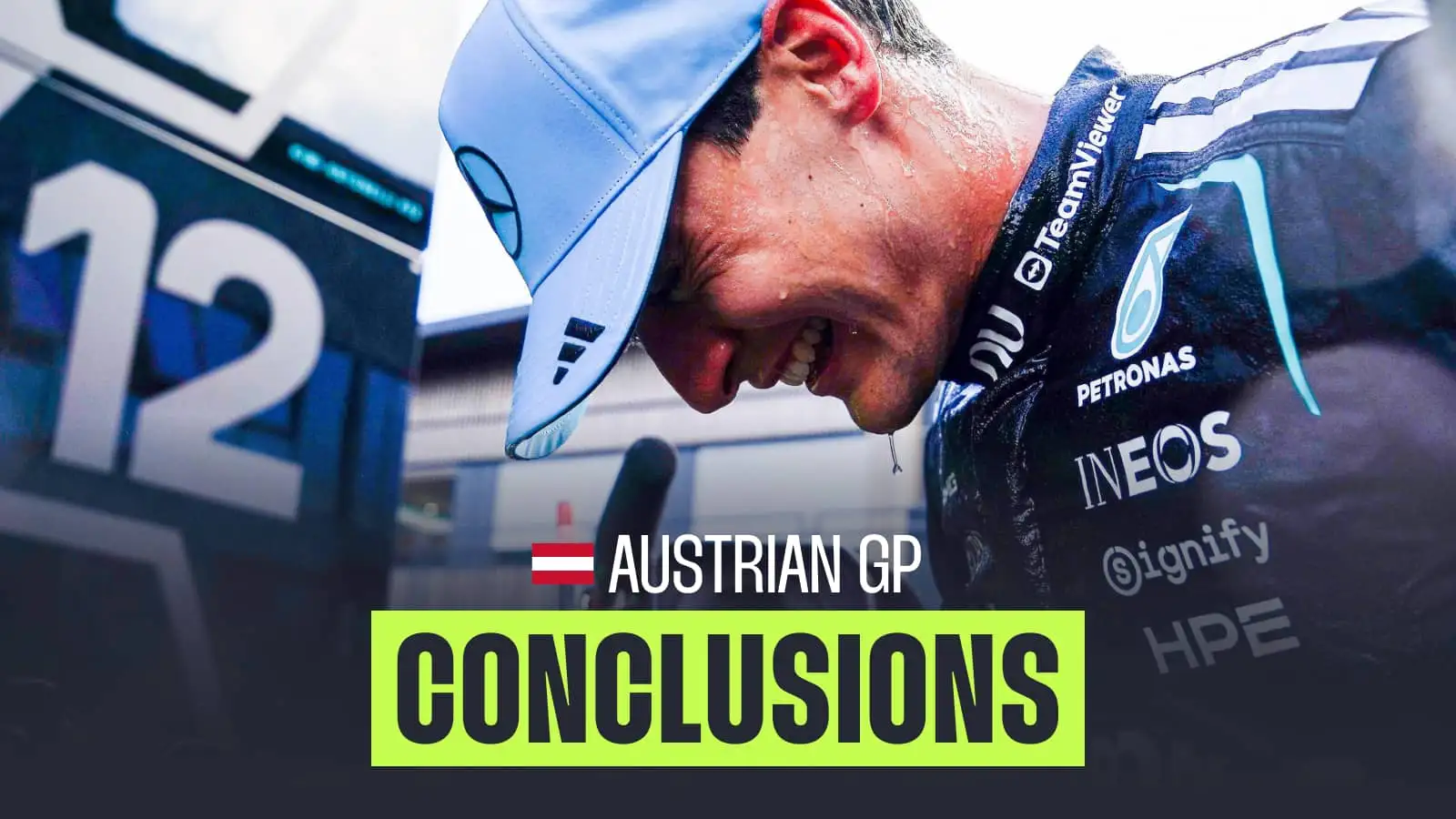
Mercedes driver George Russell claimed his second win of the F1 2026 season at the Austrian Grand Prix at the Red Bull Ring. Russell converted a controversial pole position to secure his first victory since the opening race in Australia in March, with Red Bull driver Max Verstappen second and Kimi Antonelli third. Here are our conclusions from Spielberg…
George Russell badly needed that result
What to make of George Russell’s pole position in Austria on Saturday? Some praised his situational awareness and judgement by lifting off just enough on his final Q3 lap to minimise his time loss without falling foul of the rules. Others considered it reckless and unbecoming of a driver of his experience and seniority (Russell is a director of the Grand Prix Drivers’ Association, after all) to take his chances in the face of a yellow flag. That he was allowed to keep pole sets a precedent that is best described as sketchy, not least when all the confusion of qualifying could have been avoided simply by doing things the old-fashioned way. Is there a car in the wall? Is it unlikely to be moving any time soon? If the answer to both of these questions is yes, instant red flag. Safety first every time. And to hell with whether or not that means qualifying ends under a red. An accident should not be allowed to open up an opportunity for drivers to play dare.
More than anything, that episode in the closing moments of Q3 offered an insight into Russell’s mindset at this stage of 2026. Look beyond the result of converting pole into victory and once again this was a hugely unconvincing performance. His deficit to Kimi Antonelli across the first two stages of qualifying – on the shortest lap of the season and a circuit layout that tends to conceal the differences in technique between drivers – was distinctly unflattering. He was struggling. Really struggling. Getting desperate, too, with Toto Wolff in his ear telling him to just concentrate on the driving. And now with a lap finally coming together right when it mattered most, he wasn’t going to let whatever was lurking on the other side of Turn 9 – car in the wall, rampaging deer, meteor strike – stop him finishing it. It was classic George in many ways: the calculated risk, as committed as committed gets, Mr One-Hundred Per Cent in full flow.
A couple of days earlier in Thursday’s FIA press conference, Russell began his weekend being asked about Lewis Hamilton’s return to the top step of the podium in Barcelona. “It’s great to see Lewis back doing what he does best,” he told media. “I think that’s also just such an example of how challenging Formula 1 is because the cars are so complex, the tyres are so complex, the power units are complex. Everything needs to click and if one thing isn’t clicking, you can’t get the most out of yourself.” And then, as he kept speaking, the realisation occurred. George wasn’t talking about Hamilton or Ferrari or Barcelona anymore. He was talking about himself. “It just shows that you don’t forget how to drive overnight. You need yourself, your team, the setup, the understanding of the tyres, everything to just click. And when it clicks, you fly. It’s beautiful.”
When a player goes an extended period without scoring a goal in football, people talk amusingly of him needing the ball to go in off his backside, purely for the much-needed confidence boost and sense of achievement it brings. Four months since his last victory in Melbourne, Austria felt a little like that for Russell – forcing a win over the line by any means necessary. It will not be considered one of his best victories, but in the context of the 2026 title race it may come to be remembered as one of his most important. The pace hardly oozed from him this weekend. The way he took pole position was not particularly edifying and left a bitter taste. Even when closing in on victory, he still found himself running a little wide here and a bit further wide there. It was far from perfect; nobody will look back on this as the weekend everything clicked into place again. And it would be a fatal mistake for him to fall into the trap of assuming that all his troubles in 2026 have now been overcome. But still, at the end of those 71 laps on Sunday afternoon, Russell had the feel of a winner’s trophy in the palm of his hand once more. Sometimes that’s all a racing driver needs. Sometimes the result matters more than the performance. Sometimes you just need one to go in off your backside. And maybe, like his former teammate in Barcelona, this win will help Russell remember who he is.
Max Verstappen missed the boat to join Mercedes in 2025
The three certainties in life? Death, taxes and Max Verstappen being linked with a move to Mercedes. It has become a feature of every summer over the last few years, as inevitable as sunrise itself. So brace yourself, dear reader, for weeks of breathless chatter about performance clauses and flight trackers… Only for Max to almost certainly remain exactly where he is for 2027. This much is true: stuck in seventh, Verstappen has never had a better chance to activate the clause, widely believed to be in his contract, that allows him to leave Red Bull if he is lower than second in the championship at the time of the summer break. Yet also true is this: never before have the options available to him been so limited. It is almost beyond comprehension that the greatest racing driver in the world will in all likelihood find himself stuck.
Yet to still regard Mercedes as the favourite to sign Verstappen is to overlook the fact that the game has now changed. As this column wrote incessantly in 2025, the opportune moment for Verstappen to join Mercedes was last year. Why? Because of the lingering doubts over the ultimate potential of George Russell and Kimi Antonelli. While George and Kimi offered only the promise of winning the title in 2026, Max came with the closest thing an F1 team could find to a guarantee. With Mercedes’ return to title contention imminent, there was every possibility that those concerns over Russell and Antonelli would fade away in the first half of 2026. And sure enough, with Antonelli living up to his status as Mini Max, what need would Mercedes have now to sign Old Max? Why would Toto Wolff even contemplate harming the progress and personal development of Antonelli, a driver he almost seems to regard as a son, by exposing him to Verstappen?
Indeed, almost by accident Mercedes has stumbled across a perfectly balanced driver lineup over recent months: Antonelli as F1’s latest boy wonder, Russell as the uninspiring and inconsistent number two. With Mercedes’ dominance almost certain to see Russell meet the performance targets required to trigger an automatic contract extension for 2027, it is time that the rumours of Verstappen joining Mercedes finally died. And if not Mercedes, then where? Aston Martin’s dreadful start to the new rules has taken that particular curveball off the table for the foreseeable future despite the obvious appeal of Adrian Newey and Honda. Ferrari? Not when Charles Leclerc has just signed a new contract and Lewis Hamilton is in the midst of his late-career revival. Which leaves only McLaren.
When rumours of GianPiero Lambiase leaving Red Bull first surfaced late last year, it seemed likely that whichever team signed him would stand a pretty good chance of getting Max too. For some months it looked like that team would be Aston Martin before McLaren – never seriously regarded as a contender for Verstappen previously – announced the appointment of Lambiase in April. Out of nowhere, McLaren had just entered the chat. Officially, Lambiase has been recruited to work under current team principal Andrea Stella in the role of chief racing officer when he arrives ‘no later’ (McLaren’s words) than 2028. As noted in our conclusions from Monaco, however, it feels like an open secret that Lambiase will become McLaren team boss when the position next becomes available (sources have indicated that GP may have been sold this very scenario as part of his move from Red Bull). For all the talk recently of a potential swap deal between Verstappen and Oscar Piastri for 2027, it is understood that McLaren remains happy with Piastri, who signed a new multi-year contract as recently as March last year. Next season will almost certainly come too soon for such a move to materialise. Yet expect McLaren to soon emerge as the leading destination when Max decides to leave Red Bull. Mercedes, you say? Get with the times. That’s, like, sooooo last year…
Aston Martin will benefit from Adrian Newey’s long-term vision
Has a team of such vast resource and brainpower ever looked so lost? For the second weekend running, Aston Martin was slowest by a considerable margin in qualifying in Austria – a full second slower even than Cadillac, a team still juddering along with all the teething problems that come with being so new to F1. A team of Aston’s ambition can only struggle this way for so long before those two precious commodities, belief and motivation, are sapped out of the place. “It’s weighing on everyone,” Mike Krack, the team’s chief trackside officer, told media in Barcelona. “You can feel it. You can feel it in the garage. You can feel it especially with the drivers. It’s a very difficult situation.”
Central to Aston Martin’s mid-season decline, after an already tough start to 2026, is the team’s unique upgrade strategy. Stung by the experience of 2026, Adrian Newey confirmed during his recent trackside appearance in Monaco that he has orchestrated a complete rethink of the way Aston Martin does things to prevent a repeat of this season. Rather than regularly bringing small upgrades to the car, Aston Martin has instead decided to introduce a significant package around the time of the summer break. With other teams – including Cadillac – making rapid gains at the start of a new rules cycle, it was inevitable that a stagnant Aston Martin would drift away from the pack as the first half of the season unfolded. In other words, Newey has braced the team for short-term pain with an eye on long-term gain – not just in 2026 but beyond. All very well, but if the summer break update doesn’t meet expectations either…
By Newey’s own admission, Aston Martin’s approach to this season was – how to put this politely? – a mess. With Adrian only completing his move from Red Bull at the start of March last year, it wasn’t until the middle of April – four months later than the rest – that Aston Martin finally put a model of the 2026 car in the wind tunnel. And with Newey claiming that the team only discovered in November 2025 that Honda was seriously struggling with its 2026 engine – to this day an absurd admission, not least when some of us already knew back in January – the seeds for Aston’s annus horribilis were sown. This, clearly, was no way to prepare for a season that once held such promise. It can’t happen again. And under Newey’s watch, bet your bottom dollar that it won’t. No. Everything at Aston Martin will be more considered going forward. More purposeful. Smarter. Indeed, when the upgrade finally arrives in Spa/Hungary, it will mark the first real glimpse of an Aston Martin team now being constructed in Newey’s image. The start of a new dawn. And what is it they say about dawns again? Ah, yes: the night is darkest just before that first little glimmer of light.
Carlos Sainz will not find what he wants at Williams
The problem with Williams placing such a huge emphasis on 2026? The team was always likely to fall short of its own targets. Let’s pretend for a moment that Mercedes’ dream scenario had become a reality this season, with a 2014-esque engine advantage that put the Merc-powered teams a whole lightyear ahead of the rest. What reason was there to expect that Williams would be faster than the factory team in 2026? Faster than McLaren, the constructors’ champions of the last two years? Faster even than Alpine, whose switch to Mercedes power ensured its very capable chassis would no longer be constrained by a Renault engine not fit for purpose? Seventh and eighth. That’s it. That was always going to be the ceiling for Carlos Sainz and Alex Albon on a typical race weekend in 2026 even if Williams got everything right and Mercedes got lucky over the winter.
It is said that among the keys to happiness is hoping for the best but expecting the worst. The mistake Williams made was being so open about expecting the best, making such a big deal of the opportunity presented by 2026 that everything since the turn of the year has come as a crushing disappointment. Even now, as James Vowles continues to talk with a striking lack of self-awareness about competing for world championships by 2030, there are times when it seems all sense of perspective has been lost. Sainz was sucked in by the promise of 2026 during the summer of love in 2024 when Vowles, who memorably likened their negotiations to being on a date, spent months whispering sweet nothings in his ear. His move to Williams was never about last season, even if 2025 went better than anyone – not least Carlos himself – could have imagined. This was meant to be the big one.
So now he has been limited to just six points across the first eight races, it is no great surprise that he is considering his options. PlanetF1.com revealed over the Barcelona Grand Prix weekend that Sainz is questioning his future with Williams with Audi – the team he turned down two years ago – emerging as a potential alternative for 2027. Sainz, being the respectful and gracious man he is, was careful to stress his affection for Williams on Thursday in Austria while at the same time conceding that a decision on his future will have to be made over the summer break. Despite his close relationship with Vowles, Sainz’s bond with Mattia Binotto, the man who signed him for Ferrari and worshipped the ground on which he walked at Maranello, runs even deeper. Looking back now, it seems not insignificant that Binotto was appointed by Audi just three days after Sainz’s move to Williams was made official in 2024. Had Audi brought Binotto in, say, a month earlier, might the then-Sauber team have already convinced Sainz to join two years ago? It is believed that reservations over the Audi F1 project played a role in Sainz choosing Williams following his departure from Ferrari. Yet with Audi making a better-than-expected start to life in F1, the doubts surrounding that team and its plans for the future are gradually disappearing. With great regret, the same cannot be said of Williams.
The F1 2026 season cannot end soon enough
Rest assured that there is still some joy to be had from Formula 1 in 2026. A few moments over recent weeks have hit home that, yes, as unlovable as the current cars might be, F1 still has the capacity to thrill. Think, for instance, of the battles between George Russell and Kimi Antonelli in Canada. Or Antonelli’s lap for pole, the epitome of the art, in Monaco. The latest came in Austria on Sunday with the battle between Max Verstappen and Lewis Hamilton. Suddenly the sport’s missteps of the last five years burned away as we were transported briefly back to the summer of 2021, watching those two world champions – two of the greatest drivers to ever sit in a racing car – go to war. The skill! The judgement! The aggression!
Events overtook it as the race developed, but some may remember that not long before this came a similarly delicious battle between Antonelli and Charles Leclerc. It wasn’t quite as breathtaking as Max vs Lewis, but it wasn’t far off either. Right until the moment Leclerc’s parachute opened on the approach to Turn 9, the de-rating Ferrari’s red light blinking rapidly as Antonelli overtook him with almost comical ease. Hello deployment, my old friend. And that was that: another absorbing battle between two disgustingly talented drivers cut down in its prime by the truly loathsome 2026 cars. Was it a mere coincidence that, during Hamilton’s fight with Verstappen a short time later, the camera abruptly cut away from the onboard footage as they blasted towards Turn 9? Formula 1, it must be said, has become remarkably adept at shielding the public from the most jarring aspects of the new regulations since the start of the season.
As 2026 has unfolded, it was perhaps inevitable that the world would grudgingly accept F1’s new normal as attention slowly turned away from the regulations and towards the stuff that really gets the juices flowing. Yet despite the best efforts of the FIA and the rest of F1’s stakeholders to improve the situation for 2026 and beyond, Verstappen did not appear to be wrong when he claimed in April that any changes will not fix a set of rules that remain fundamentally flawed. As weird seasons go, 2026 will come to be remembered along with the pandemic-affected year of 2020 as one that existed in a strange sort of bubble; one we would all rather move on from and never speak of again. Expect the debate over F1’s act of self-harm to reignite this weekend at Silverstone, where the energy-management demands are so extreme that Verstappen was recently left laughing to himself in the Red Bull simulator. Strange to say when there are 14 rounds still to go and a title race is simmering nicely. But the end of this season – and a return to some form of normality in 2027 – cannot come soon enough.
Read next: Do Fernando Alonso’s Aston Martin comments stand up to scrutiny?
Source:PlanetF1 News